Saturday, 12 March 2016

Sepia Saturday: Hats off to James Carroll

Sepia Saturday prompts bloggers to share their family history through old photographs. 

Their suggestion this week shows a British Grenadier Guard kissing a woman during a visit to Sydney in 1934, but the Guard’s towering bearskin cap hides most of the action. Indeed, hats of all kinds feature most prominently in this picture - nearly everyone is wearing one.


So today, as part of our family history, I thought I'd tell the story of James Carroll and share with you some of his photos. They feature a variety of great hats. James Carroll was Teresa (Carroll) Wynne’s older brother. Actually, he was her half-brother, the son of Maurice Carroll and his first wife, Mary Anne Frazer. That makes him my half-great-granduncle.  

James Carroll was born in Balheary, in Swords, Co. Dublin, 150 years ago, on 4 November 1865. His mother died of tuberculosis when he was only two years old, but, by the time he was four, his father had remarried. Anne Radcliffe was twenty years of age when she married Maurice and became mother to his surviving children. Although, five children have been identified in baptism records – David, Robert, Catherine, Thomas and James – some may have died prior to Maurice and Anne’s marriage. James probably had no memories of Mary Anne for he named Anne Radcliffe as his mother later in life.

Three days after his twenty-first birthday, James married Anne Molyneux in the Pro-Cathedral in Dublin. His bride was originally from Ballymore Eustace in Co. Kildare. The young couple had three boys born in Dublin city, Maurice in 1887, William in 1889 and James in 1891. Sadly, William died.  

James and Anne (Molyneux) Carroll in later life

About 1901, the family migrated to Newcastle upon Tyne, in England. During the census that year, James, Anne and their son James were living in a lodging house in Elswick, seemingly having just arrived in the town. James had found work as a general labourer. Their eldest son Maurice was temporarily left behind with friends in Ireland.

Sir W. G. Armstrong, Whitworth & Co., Ltd, Newcastle
James Carroll in his fire officer’s uniform 

By 1911, James was well established  in Newcastle, where he worked for Sir W. G. Armstrong, Whitworth & Co., Ltd, then the largest manufacturing company in Britain.  James was a fireman in their fire department. Both his sons also worked for the company, Maurice as a ship joiner and young James as an apprentice electrician in their gun department.

The Armstrong Whitworth fire-engine

After James retired, he moved out of Newcastle with his wife Anne and they spent some years living in the Northumbrian countryside, first in a place called Twice Brewed and later at Tow House, near Bardon Mill. During the war years they moved back to Newcastle to live with their son James, who was known as Jimmy. James died on 22 December 1943. His wife did not survive him by very long and within six months, on 18 June 1944, she too passed away.

Anne (Molyneux) Carroll in later life

To see what stories other Sepians have under their hats this week, head over to Sepia Saturday.

Sources: Copy birth, marriage and death registers, General Register Officer; Church records on RootsIreland.ie and IrishGenealogy.ie; 1901 and 1911 Census of England and Wales, accessed on Ancestry; information after 1911 and Carroll family photographs received, with much appreciation, from the great-grandchildren of James Carroll in Newcastle. Thank you Rosalie, Brian and Rosemary. 

………………
© Black Raven Genealogy

Saturday, 5 March 2016

The way they were

One night this week ‘Storm Jake’ battered Ireland, bringing with it gale force winds and freezing temperatures. But with all the comforts of modern living – central heating, double glazing, a warm duvet, and even an electric blanket – it didn’t cost me a moment’s sleep. My nineteenth-century ancestors would not have been so lucky.

Andrew and Anne (Clinch) Byrne, my third great-grandparents, had two boys christened with the name Gareth, two christened Andrew and two girls christened Anne.  Such repeating names are testament to a high rate of infant mortality, more than likely caused by the wretched conditions in which they lived. 

Even, compared to my forefathers in Malahide, it seems those in Co. Kildare were poor. The little cottage where the Byrne family once lived, seen last week on a mid-nineteenth century map in Athgarvan, Co. Kildare, was probably built with clay and thatched with straw. Such dwellings survived in large numbers in this village until the very end of that century and well into the twentieth.[1]

Interior of a mud cabin at Kildare, c. 1870

A government inquiry conducted in the early 1830s makes for sobering reading. Labourers’ cottages in Leinster often had only two rooms, a kitchen and a bedroom, though the poorest only had one. The cottage floor usually comprised the unprepared soil on which the dwelling stood and the roof was often thatched so poorly it leaked in heavy rain.  The tiny windows were rarely glazed, being boarded-up in winter with straw or maybe a piece of old bagging. These homes were dark and gloomy.[2]

One redeeming feature might have been the fireplace, used for heating and cooking. Kildare boasts a large area of bog, so turf fuel was probably readily available. You can imagine the little cottage being cosy on a good night, when the neighbours gathered for the music and the craic… but in winter?  How did they endure the cold, and the damp and the drafts?

And, it’s not as if they had comfortable furniture and bedding.  There were probably a few stools, a rough table and possibly a dresser. Often, there was only one bed, shared by the parents and all their younger children. As the children reached about eight or nine years old, they typically moved to separate beds of straw on the floor, one bed for the boys and one for the girls. In poorer cottages there was no bedstead at all and everyone slept on the floor.  Can you imagine?  It’s hard to believe. This is how ‘our’ ancestors lived. It probably wasn’t even fit for my ponies.

Blankets were also scarce, seemingly. Many were comprised of a patchwork quilt of old coats or other coarse unwanted materials, stitched together. In some cases, the only blanket was the man’s ‘great-coat’ and the whole family huddled beneath it for warmth at night. On a wet day, you can imagine the kids thinking, ‘Dad, get in out of the rain’ as they contemplated another long damp night shivering in the dark.[3]

William Henry Carter, Esq, a gentleman from Kilcullen, just two miles from Athgarvan, described living conditions in his area in the early 1830s as: 
‘Generally miserable: mud houses, thatched with straw; badly furnished. Bedsteads not general; bedding would be wretched were it not for the blankets given from ladies’ associations, and private charity’.[4]   

I find myself seeking evidence that ‘my’ ancestors had a better life than this, but it’s doubtful. A taxation survey in 1853 placed a rateable valuation of only fifteen shillings a year on Andrew Byrne’s house and potato garden. There were worse hovels houses than this in the area, but only just.[5]

_____________________
[1] House and Building Return (Form B), Blackrath and Athgarvan, Co. Kildare, 1901 Census, National Archives of Ireland.
[2] Poor Inquiry (Ireland), Appendix E, First Report of the Commissioners, 1836, pp 42-43, accessed Google Books.
[3] Same, pp 71-73.
[4] Same, Supplement to Appendix E, p. 60.
[5] Griffith’s Valuation, 1853, Blackrath and Athgarvan, Greatconnell, Co. Kildare, accessed Ask About Ireland.

Image credit: Print collection of Maggie Land Blanck, citing the Illustrated London News, 9 April 1870. 

.......................
(c) Black Raven Genealogy

Saturday, 27 February 2016

Escape to the Country

I’m from Dublin, and even though I now live in ‘lilywhite’ Kildare, I consider myself a ‘true blue’ Dub. As far back as I’ve managed to trace, all my direct ancestors lived in Dublin, either the city or the county. It’s not that they didn’t like to travel. Many of them did. They headed to the four corners of the globe, but they always left us, their descendants, behind in Dublin.

Oh, some of them hinted at being from ‘down the country’, as we say. On Mam’s side, the Hynes family have reported connections to Co. Limerick and the Carrolls to Co. Tipperary. Dad’s great-grandmother, Elizabeth Mahon’s mother, was said to have been born in Co. Meath. And, my DNA matches show a distinct bias towards Co. Clare. But, it’s not been possible to find any actual documentary proof of anyone, anywhere, prior to their arrival in Dublin.

Until now, that is.

When my Dad’s great-grandfather John Byrne married his first wife, Mary Markey, in Dublin city, in 1860, his parents were named as Andrew Byrne and Anne Clinch, from Newbridge. Then, when he married my second great-grandmother, Alicia Leahy, in 1867, his parent’s address was further defined as Athgarvan, in Kildare.[1]

Athgarvan today is a small village on the River Liffey, about two miles from the town of Newbridge, and coincidently not five miles from where I now live.  In the nineteenth century, it was a tiny settlement near an extensive flour mill. It’s hard to imagine why anyone would live there, unless employed at the mill, and Andrew Byrne was said to have been a gardiner [sic].[2]

But, Athgarvan is exactly where I found them. John Byrne was baptised in the Catholic parish of Newbridge, in the diocese of Kildare and Leighlin, on 14 February 1841. His parents were Andrew (Andy) Byrne and Anne Clinch/Clynch from Athgarvan. They married, not far away in the parish of Suncroft, on 11 November 1833. The Newbridge parish register confirms the family made Athgarvan their home.[3]

Children’s baptisms                        Baptism Sponsors [4]
Garrett, Sep 1834, Athgarvan            Michael Burne and Anne Burne
Garreth, Jun 1835, Athgarvan            Michael Burne and Ann Burne
Thomas, Aug 1838, Athgarvan            Edward Clynch and Mary Byrne
John, Feb 1841, Athgarvan                 Laurence Byrne and Anne Salmon
Andrew, Nov 1843 , Athgarvan           John Clynch and Mary Clynch
Mary, Oct 1846, Athgarvan                 Charles Neile and Julia Bernes
Anne, Oct 1846, Athgarvan                 James Darcy and Ann Byrne
Edward, Nov 1850, Athgarvan            Thomas Bernes and Ellen Kealy
Anne, May 1853, Athgarvan                James Byrne and Rose Darcy
Andrew, Mar 1855 , Athgarvan           David Bruce and Bridget Kelly

In September 1853, when Griffith published his property tax survey for the area, Andrew Byrne was found living at Athgarvan Cross. He leased a house and a small garden at 2e on the map below.

Excerpt Griffith’s Valuation, Athgarvan, Co. Kildare, 1853

It’s quite likely this Andrew Byrne was my third great-grandfather. Many of his neighbours sharing the eight little cottages at plot 2 on the map were present at his children’s baptisms: Laurence Byrne of 2g was John’s Godfather; Charles Neill of 2h was Mary’s and the Darcy family lived at 2d. Patrick Clynch, also likely a relative of Andrew’s wife, lived at 2a.[5]

So finally, I’ve found my roots outside of Dublin. Maybe that’s why the Kildare countryside always felt so much like ‘home’.


[1] Church records on Irishgenealogy.ie. 
[2] Copy Marriage Register, Byrne-Leahy, 1867, General Register Office.
[3] Catholic Parish Registers at the NLI, Newbridge, Baptisms, Jan 1834 – Oct 1846, p. 76; Suncroft, Marriages, May 1805 – Aug 1881, p. p. 81. 
[4] Catholic Parish Registers at the NLI, Newbridge, Baptisms, various.
[5] Griffith’s Valuation, 1853, Blackrath and Athgarvan, Greatconnell, Co. Kildare.

Image Credit: Griffith’s Valuation, Athgarvan, Ask about Ireland.

………………………
© Black Raven Genealogy

Update: See here for 'further reflections' on where Andrew Byrne was really living in 1853.

Saturday, 20 February 2016

All about John Byrne

Carrickbrennan Graveyard, Monkstown, c.1835.

Sometimes, when seeking out our elusive ancestors, all that remains of them are documents recording their births, marriages and deaths.  Don’t get me wrong, I count myself VERY lucky to locate these vital records. But, once I have them, usually I want more. I want to know an ancestor’s true character. I want to know their life-story.

Yet, as we go further back in time, memories of past lives fade into oblivion. After a century or more has passed, there’s often no other option but to read between the lines of these fragmented BMD documents, to get a sense of the person they once were. And, that’s how it was with my paternal second great-grandfather, John Byrne. Nothing at all was remembered about him.

So, I set about piecing together an account of his life:-

He was barely eighteen years old when he left behind the tiny village of Athgarvan, Co. Kildare, where he had spent his childhood.  This was in the immediate aftermath of the Great Famine. Perhaps John was too poor to afford the boat fare to America, because, like so many of his poorer countrymen, he moved to Dublin city instead.  There, he lived at 29 Upper Mercer Street with his friend John Darcy, and presumably he found work as a domestic servant.

Once in Dublin, he met a girl named Mary Markey. Mary also lived in the city, away from her parents. Perhaps she too was a domestic servant and met up with John at work. It wasn’t long before the young couple found themselves in a spot of trouble.

Unmarried, on 10 December 1859, Mary Markey had a baby daughter who she christened Mary. John Byrne was named as the father. His friend, John Darcy and Catherine Byrne, maybe his sister, were the child’s Godparents. Can you imagine how difficult this time must have been for them? 

The young parents were probably barely able to support themselves, let alone raise a family. They waited until after the child was born alive and healthy before they agreed to get married. Or, maybe that decision was made for them by someone else.  Either way, the following month, on 8 January 1860, John Byrne and Mary Markey wed in the Church of St Nicholas, Dublin. Their witnesses were John Darcy and Catherine Byrne.

And that was the last record so far found relating to Mary (Markey) Byrne and her daughter. Seven years later, on 27 January 1867, John married my second great-grandmother, Alicia Leahy, in Dublin. Strangely, at the time of this marriage, John said he was a bachelor, i.e. not married previously. His friend John Darcy witnessed his second marriage too and 'overlooked' his claim.  Presumably, John’s first wife had died.

By 1867, John was a servant living at Yapton, in Monkstown, Co. Dublin. This must have been his employer's address. John still resided at Yapton later in 1867 and in also 1868, when he registered the births of his sons Michael and Thomas. The boys were born nearby at Mounttown, in Kingstown. Perhaps John lived with his employer and only saw his family on his time off.

Sadly, shortly after Thomas was born, tragedy struck again and John was widowed a second time. Alicia Byrne died at Mounttown, on 9 January 1869. She was only about twenty nine years of age. She suffered from heart disease and acute rheumatism for ‘some weeks’ before the illness finally took her life. John did not register her death and may not even have been present at her hour of passing.

What became of the boys?  It seems the family could not live with John when Alicia was alive. So, presumably, it was even less feasible after her death. My guess - this is how my great-grandfather ended up in Malahide, being raised by his aunt, Alicia’s sister, Mary (Leahy, Radcliffe) Power.

What became of Mary Byrne, John's eldest child, born to his first wife Mary Markey?  I wonder if she survived. Perhaps she was raised by her mother’s family too. Coincidentally, or maybe not, Mary Markey’s parents were from Malahide. My great-grandfather may even have known his half-sister growing up.

What became of John Byrne himself?  Well, maybe time (and a whole lot more research) will tell.

Source: Church records on IrishGenealogy.ie; Copy birth, marriage and death registers, General Register Office; The Dublin Penny Journal, 31 January 1835, JSTOR. 

…………………
© Black Raven Genealogy

See more about John Byrne's first family here at His first family. 

See more about where John Byrne came from at: Escape to the country.

Saturday, 13 February 2016

The brick wall crumbles!

My great-grandfather’s copy birth register arrived in my inbox this week, shattering my longest standing genealogy brick wall. It’s been over a week since I ‘found’ him, but with all the false starts previously, until I held the certificate in my hands, I was afraid to believe it was really true.  Two separate records, sixteen years apart, had told me Michael Byrne’s father was a butler, and this is what I waited to see confirmed.

The document didn’t quite describe John Byrne as a butler, though. It said he was a servant. Being a butler was probably far more prestigious than being a mere servant, yet it is not unfitting for a man’s family to remember him well, after his death, and maybe even elevate his status a little, too. Possibly John Byrne aspired to become a butler, and maybe he achieved that goal, after Michael’s birth. In any event, I’m taking this as a match.

Until this week, much of what I ‘knew’ about Michael Byrne was contained in the registers of his 1892 marriage to my great-grandmother, Elizabeth Mahon. Here, his father was named as John Byrne, the butler, and his mother as Elisabeth.[1] Additionally, the 1901 census indicated Michael was born about 1867-68, in Co. Dublin.[2] It wasn’t much to go on, but it ought to have been enough to find him, had all the details been correct.

More recently, I learnt of Michael’s brother, Thomas, who died in childhood at the home of Mary (Leahy, Radcliffe) Power. Thomas became the linchpin connecting the boys with their parents. It turned out Mary Power was their maternal aunt – and their mother was Alicia, not Elisabeth.

Michael Byrne was born on 2 December 1867 in Kingstown, Co. Dublin, the son of John Byrne, a servant, and Alicia Leahy. His brother Thomas was born the following year. Mary Power, who looked after Thomas in his final days and Alicia, the boy’s mother, shared the maiden name ‘Leahy’. And, sure enough, my suspicions were confirmed, Mary and Alicia were sisters.

When Alicia married John Byrne in 1867, her parents were named as Michael and Bridget Leahy of Cuffe Street, Dublin. When Mary married Christopher Radcliffe the previous year, her parents were named as Michael Leahy and Bridget Lynch.[3] Sisters!

Now, I can take some comfort from having extensively and unsuccessfully searched for Michael Byrne, the son of Elisabeth.  If his mother’s name was Alicia, I was never going to find him.

And, the clues were there all along, except I failed to recognise them. Margaret Byrne, her fifteen-year-old grandniece, was staying with Mary Power on census night in 1911.[4] With hindsight, I can easily conclude this was my great-grandfather’s only daughter, Margaret Byrne. Maggie, as she was known in the family, was born on 2 October 1897, making her only thirteen years old on the night in question.[5]

But the age difference was not the reason I didn’t recognise her.  The truth is I wasn’t looking for her. I had already found her, or so I thought, tucked up in bed in her father’s household, on that same night, and her father said she was fourteen years old.[6]

Next, I have to figure out why Thomas Byrne was staying with his maternal aunt at the time of his death, and if something had happened to his parents, John and Alicia Byrne.

………………………………
© Black Raven Genealogy


Continued further at:  All about John Byrne.


Update July 2016 - And, if there are any lingering doubts that Mary Power was Michael’s aunt, here it is confirmed in writing: Q.E.D.  


[1] Copy marriage register, Balrothery, 1892, General Register Office.
[2] 1901 Census, James Mahon household, Malahide, Co. Dublin, National Archives. 
[3] Church records, IrishGenealogy.ie.
[4] 1911 Census, Mary Power household, Malahide, Co. Dublin, National Archives.
[5] Ireland, Select Catholic Birth and Baptism Registers, 1763-1912, Ancestry.co.uk, citing baptism register for Malahide parish. 
[6] 1911 Census, Michael Byrne household, Malahide, Co. Dublin, National Archives. 

Saturday, 6 February 2016

Chasing the elusive Michael Byrne, again

Michael Christopher Byrne, my paternal great-grandfather, has long been the bane of my life, genealogically speaking. Saddled with his way too common surname, and fettered by a lack of information, even though he was born after birth registration commenced in Ireland, I’ve been unable to find his origins.

Frustrated by the lack of progress, like any self-respecting genealogist might be, I even started to suspect Michael Byrne had something to hide and, from the grave, was actively thwarting my efforts to uncover his past. Now, I’m hoping his newly identified brother, Tom, will help us over this genealogy brick wall.

As discovered last week, when Tom died in 1876, aged seven, he was staying with Michael Power and his wife Mary (Leahy, Radcliffe) Power in Malahide, Co. Dublin.[1] With this information in mind, I started the search for Tom’s birth and of the many hundreds of boys with this name registered in 1868-69 one in particular somehow caught my eye.  Thomas Byrne was born in 19 November 1868, to John Byrne and Alicia Leahy – ‘Leahy’ as in Mary Power’s maiden name.[2]

We know from the register of my great-grandparent’s marriage, Michael’s father was John Byrne, but his mother was named as Elisabeth – not Alicia – which I admit is a tad inconvenient.  But, for whatever reason I was drawn to this family and when I discovered John Byrne and Alicia Leahy had one other child - Michael Byrne, born on 2 December 1867 – they really grabbed my attention. Could I have found my great-grandfather, notwithstanding his mother’s unexpected given name? 

Both Thomas and Michael were baptised in Kingstown (now Dun Laoghaire) about as far away from Malahide as you can get, and stay in Co. Dublin.  

Event                                                          Sponsors [3]
Baptism of Michael Byrne, 1867                   Peter Radliff and Mary Radliff
Baptism of Thomas Byrne, 1868                  Thomas Evans and Anne Newton

Yet, I recognise Michael’s Godparents as being from Malahide. Mary Radliff [Radcliffe] was likely the same woman as Mary (Leahy) Power, with whom our little Tom was staying when he died. In 1867, she was married to Christopher Radcliffe, who died young. Peter Radliff [Radcliffe] was her brother-in-law. Coincidentally, Christopher and Peter were my third great-granduncles, on my mother’s side.

By the way, the copy pages of this baptism register are available on the National Library web-site, but check out the page with Michael’s details. Out of the entire book, that very section of the relevant page failed to upload.[4] Now do you see how he tries to thwart our progress?


The information in any marriage register is provided by the bride and groom to the priest and you would expect the groom to know his own mother’s name. So, it’s hard to know why Michael’s mother was down as Elisabeth, if her name was Alicia. But, sometimes people misremember pertinent facts or maybe the priest just erred when he wrote it down.

If it does turn out our Michael and his brother Thomas were baptised in Kingstown, this brick wall is well and truly busted. John Byrne married Alicia Leahy in St Mary’s Pro-cathedral in Dublin city on 27 January 1867. His parents were Andrew and Anne Byrne from Athgarvan, Co. Kildare and the bride’s parents were Michael and Bridget Leahy with an address at Cuffe Street, Dublin.[5]

Chris Mahon (our distant relative) was wrong. He said the Byrnes were blow-ins from Co. Wicklow and it now seems we were blow-ins from Co. Kildare!

Although I’ve convinced myself these are my ancestors, it really is only conjecture at this point. Hopefully, when I receive a copy of the birth and marriage certificates, it will show John Byrne worked as a butler. Otherwise, there will be one terribly disappointed genealogist in the family.  


[1] Copy death register, Thomas Byrne, 1876, Balrothery, General Register Office.
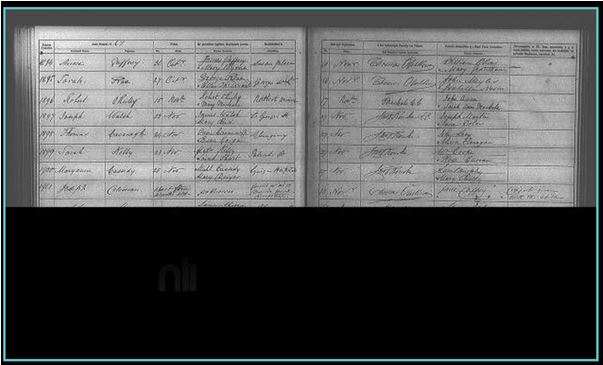
[4] Baptisms 9 Aug 1861 – 7 May 1869, p. 133, Kingstown, National Library. 
[5] Marriage register, St Marys Pro-Cathedral, IrishGenealogy.ie.

Continued further at: The brick wall crumbles!

……………………
© Black Raven Genealogy

Saturday, 30 January 2016

A glimpse over the brick wall

I’ve just made a genealogical breakthrough – one that might lead me to the origins of my Dad’s paternal grandfather. Michael Christopher Byrne is my longest standing genealogy brick wall and I’ve travelled every conceivable avenue in the search of him - with zero results. Now, there’s more than a glimmer of hope he’ll soon be found.

Do you remember a few weeks ago, back in December, I was following up on a family story about Michael’s rumoured brother, Tom, the child who supposedly died when he fell out of a tree? Well, it seems that story was true after all.  

I found Tom!

Thomas Byrne was only seven years old when he died on 15 May 1876. He suffered from acute hydrocephalus, a condition more commonly known as ‘water on the brain’. And, one of the common causes of hydrocephalus is head trauma, which is not inconsistent with a fall from a tree. The poor little chap survived for three weeks before his death, yet the doctor could do nothing to save his life.

Tom’s death certificate contains a wealth of information. He was described as being the ‘son of a butler’. My great-grandfather’s marriage certificate confirms his father was a butler, though unfortunately, neither record gives any clue as to where the man worked.

The biggest surprise on the death certificate was Tom’s last address. He died in Yellow Walls - the same townland in Malahide, Co. Dublin where I grew up – where Michael Byrne married Elizabeth Mahon in 1892. So, the Byrne family was in Malahide at least sixteen years before my great-grandparent’s marriage.

People in rural villages have awfully long memories. More than 100 years after Tom died in Yellow Walls, the Mahons still claimed us Byrnes were ‘blow-ins from Co. Wicklow’. So, I had expected Michael Byrne was from somewhere other than Malahide, and now it seems he lived there from childhood. He probably did come from somewhere else originally, as chances are I would have found him by now, otherwise.

Back to Tom - Neither his father nor his mother registered his death. Four days after the sorry event, a man named Michael Power made his way to the village of Malahide and informed the registrar of the boy’s passing. Michael Power was with Tom when he died. I doubt Tom was out socialising while suffering from acute hydrocephalus, so he must have been living with the Powers in Yellow Walls.

The question is - why? And where were his parents?

I have come across Michael Power before. It is actually quite intriguing just how often the Powers turn up in my research. In 1873, Michael Power married Mary (Leahy) Radcliffe. Mary was the widow of Christopher Radcliffe, my mother’s second great-granduncle. In 1894, Mary Power was Godmother to Dad’s paternal uncle, John Byrne. And, at the time of the 1901 census, Dad’s mother and her elder sister were ‘living ‘in foster-care’ with Mary Power. Now, here they are, yet again, taking care of poor little Tom.

Michael and Mary Power lived in ‘Rose Cottage’, just up the road from ‘Black Raven’, on the corner of Estuary Road and the Swords Road. When my great-grandfather got married, he gave his address as Yellow Walls, and three months earlier, when he purchased his first dog licence, he said he lived on the Swords Road. Rose Cottage is in Yellow Walls, on the Swords Road.

Is it possible Michael Byrne grew up in Rose Cottage? Perhaps either Mary or Michael Power was a relation of ours. Or, perhaps the two Byrne boys were orphaned and were ‘fostered’ by the Powers. Or, maybe I’m just losing the run of myself.

Next… well, I’ll see if I can find Tom’s birth register. And, I’ll take another look at the Powers. I do have a good feeling this time. For the first time in ages, there are ‘next steps’ in the search for Dad’s grandfather. 

Source: Copy death register, Thomas Byrne, 1876, Balrothery, General Register Office; Image credit: Pixabay

Continued further at:

……………………
© Black Raven Genealogy