Showing posts with label Place: Malahide. Show all posts

Sunday, 23 May 2021

Amazing family history to be found on Facebook

There are all these cool local-history Facebook groups popping up everywhere now, and two great ones for Malahide, Co. Dublin, the village where I grew up. One of them is a 'closed' group, but the other is open to anyone who requests access - Old Malahide History. Group members enthusiastically share their old photos of Malahide, and its people. Each new photo starts a conversation that sparks old memories. I love these groups, not just for the fascinating local history, especially about the townland of Yellow Walls, but also for all the amazing 'new to me' family history too.

I'm sharing some of my favourites, for those not on Facebook, and so you can see the type of gems that might be waiting for you to find. 

Here's a photograph I came across of my Dad with some of his old pals. Pure magic! I have never seen a picture of my Dad like this one before. It was probably taken in the mid to late 1940s. Dad was born at the end of 1937 and he looks no more than about ten years old here. Do you agree? He is in the front row, third from the left, with the dark tie, and named Michael 'Jerks' Byrne. The photo was supposedly taken near where the houses at 'Ard Na Mara' were later built.

Back row: Seamie Nugent, Joe Ryan, Patsy 'Nugget' Nugent, Gerry 'Bangers' O'Neill, Paddy Condron, Unknown, John 'Gunner' Kennedy
Front row: Unknown, Andy Carty(?), Michael 'Jerks' Byrne, John 'Skinner' Ryan

Here's a colourised version. Doesn't the added colour (authentic or otherwise) really bring the picture to life!


I also like the following one of the Yellow Walls gang. Dad and his older sister, my Aunt Maisie, are in it. The photo was likely taken two or three years after the last one, probably about 1950. The kids often played at an unused area on Sea Road, near the crossroads at Yellow Walls - maybe this was taken there. Maisie is the blond girl, with the dark coloured dress and cardigan, in the middle of the back row, and Dad is kneeling in front of her, third from left (you might miss the tiny little fella hiding to his right!).

Back row: Kay or Jean Condron, Ellie Condron, Renee Condron, Maureen Curran, Rita Ryan, Maisie Byrne, Joe Ryan?, Paddy Kennedy, Joe Condron
Front row: ?, tiny lad, nearly hidden?, Mick Byrne, Brendan Leonard, Cyril Lee, Piero Farrell, John Ryan, Brendan Leggett?
(Names crowd-sourced on Facebook, subject to correction)

And this one. The old Barracks in Yellow Walls, where I believe Lord Talbot housed his Fencible regiment, in eighteenth century. I passed it every day walking home from school, and it looked just like this, right down to the old dog sitting at the gate. By then, it was used as a farm shed. Now it is gone, replaced by housing developments.


One commentator reminisced, 'I remember the auction in 1958/59 when they sold off the contents of the house and yard. Mick Byrne bought a wardrobe for 5/-. The bonus was a banjo stored on the hat shelf.' We never heard this story. He also said my Dad was 'a great piper', which he was, and mentioned his nickname 'Jerks' and 'Sweet Afton'.

Where the nickname 'Jerks' came from, I've no idea, other than Dad inherited it from his father. As a young lad, Dad was also called 'Little Jerks'. Dad smoked Sweet Afton when we were young, switching to Carrolls later. I remember him going to McAllister's Garage of an evening after work, to buy his newspaper, his smokes (in their pretty yellow packet) and a liquorish pipe or a fizzle stick for us.


The above picture was taken a little further down the road from the Barracks, towards Barrack's Bridge, on Old Yellow Walls Road, on the way to our house. Intriguing! I can't say I remember the cottage on the right. Was it gone before my time?  Except, I do have a huge sense of déjà vu. I wonder if the scene is merely imprinted on my DNA. The road probably looked more like this in the days when Dad was walking home from school. His parents and grandparents also walked this way, in their day.


This photo of the Back Strand was snapped before my time too. It must have been colourised, it came out well enough. Years ago, they built a new road into the village, on the strand itself, right where these geese are wandering. No wonder the road is prone to flooding now! So many times I've seen pictures of cars parked there, in a foot or more of seawater - destroyed.

Such amazing photographs!  Such cherished memories!

Dad would have loved to see these. And tell me one of his stories.

Thank you, thank you, thank you, to all our old neighbours for sharing them on Facebook.

Sunday, 11 August 2019

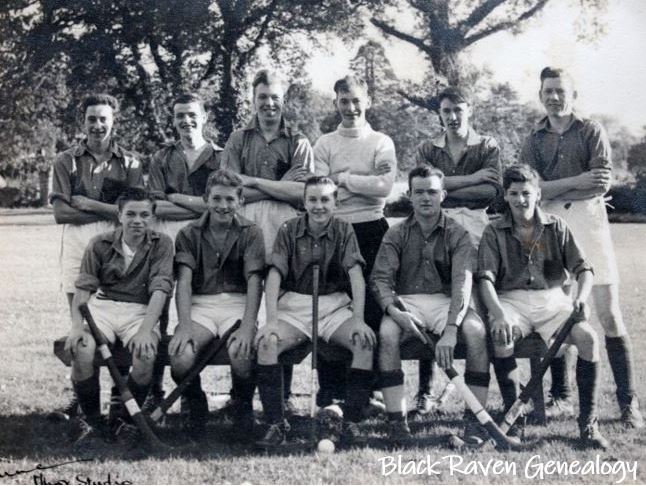
Sunday Pictorial ~ Malahide Hockey Team c.1954-55

Malahide Hockey Team c. 1954-55
Back row: Joe Connolly, Henry O’Shea, John Gilmartin, David McSwiggan, Conor McMahon, Nicky Thompson. Front row: Richard (Dick) Thompson, Mick Byrne (my Dad), Brian Kearns, Conor Dignam, Jim Thompson.

According to my Dad, the Hockey Team practiced in the Cricket field, at Malahide Castle. 

Here's the picture 'colourised' via a free online service. They attempt to generate a plausible, although not necessarily accurate, representation of any black and white photograph. Maybe the boys look a bit off colour (it probably wasn't designed with our pale Irish skin in mind) but I like it. 


If anyone knows any stories about the hockey team, I'd love to hear them.

See ColouriseSG, as mentioned recently on DNAeXplained.

Saturday, 4 November 2017

‘Black Raven’ and the Mahon lineage

Our ‘proven’ Mahon lineage goes back as far as Patrick Mahon, who died in Malahide, Co. Dublin, on 6 December 1865, at the stated age of eighty-one years.[1] Our family home today is situated on the same site leased by Patrick in 1848.[2]

'Ownership' of the site has been traced from 1848 to the present day. The holding was passed from Patrick Mahon to his son, James, and from James Mahon to his son-in-law, Dad’s grandfather, Michael Byrne, and eventually to us. Also, James Mahon’s parents were explicitly named as Patrick and Jane Mahon, when James married Margaret McDonnell, on 27 May 1866.[3] There’s little doubt Patrick Mahon was my third great-grandfather.

I’ve often wondered if the house, officially named ‘Black Raven’ in the early twentieth century, was the exact same one where my family lived during the Great Famine.

Further information about Patrick's property is now available in the records of the Valuation Office, recently published online. The House Books contain a description of Patrick's home in 1846, at the outbreak of the Famine, and it was there I may have found the answer to this question.[4]

House Book, Patrick Mahon, Yellow Walls, Malahide, 1846

The ‘quality letter’ applied to Patrick’s dwelling – ‘3C+’ – describes the appearance and condition of the house in 1846 and confirms it was not the same house standing on the site today.

‘C+’ was the code used for buildings that were ‘old, but in repair’, at the time the survey was conducted. The designation ‘3’ signified Patrick lived in a ‘thatched house with stone walls with mud or puddle mortar; dry stone walls pointed or mud walls of the best kind’.  

Even before modern-day remodeling, our house had ‘stone walls with lime mortar, and a slated roof’. If the roof had been thatched back then, and only slated later, our home would still have achieved a ‘2’ designation. So, it's likely, Patrick’s house in 1846 was knocked down at some point and replaced with a new one. 

I still don’t know if Patrick Mahon built ‘Black Raven’, of if it was built by his son James. Probably, it’s more likely, James built the new house, soon after Patrick’s death, and around the time of his own marriage.

'Black Raven', as it appeared in the late 1960s, can be glimpsed in the little picture at the top of the page.

[1] Copy death register for Patrick Mahon, Balrothery, 1865, vol. 17, p. 289, General Register Office. 
[2] Patrick Mahon, Malahide, Griffith's Valuation, Ask about Ireland.
[3] Jacobus McMahon and Margarita McDonnell, in the marriage register of St Mary's Pro-Cathedral, Dublin, 27 May 1866, Microfilm 09160/01, National Library.
[4] Patk Mahon, Valuation Office books 1824-1856, House Book, Yellow Walls, Malahide, 25 Jul 1846, National Archives.  

…………………
© Black Raven Genealogy

Saturday, 3 June 2017

Buried in Fingal

Last month, Fingal County Council released a superb new FREE online database called ‘Buried in Fingal’. It contains the details of 65,000 people buried in graveyards across north county Dublin, from the late nineteenth century onward. It was exciting to think these registers might contain the answers to many of my open questions! 

St Sylvester's Cemetery, Malahide, Co. Dublin, 2016
Yellow Walls Cemetery, Malahide, 2016

First off, I found my paternal grandfather, James Byrne. He died at his residence in ‘Far Yellow Walls’ on 22 December 1964. He was buried that Christmas Eve in the graveyard at Yellow Walls, Malahide.[1] 

Burial of James Byrne, 1964, St Sylvester's Cemetery, Malahide, Co. Dublin
Burial of James Byrne, Yellow Walls Cemetery (click on image to enlarge)

We always knew James shared a grave with his wife Lena (O’Neill) Byrne. I cannot show you the page with her details unfortunately, as it failed to load fully to the website. But, by downloading the register for the entire cemetery, I could scroll to the relevant page and see her entry. It confirms she died at her residence on 27 October 1956 and that James organised her funeral the following day. He paid a £5 burial fee, or maybe that was the cost of the plot.[2] 

James Byrne’s father, Michael Byrne, died in Yellow Walls on 22 December 1927 and by unhappy coincidence he too was buried on a Christmas Eve.[3] I had hoped these registers would confirm where exactly he was buried. The Yellow Walls Cemetery opened in 1918, but he’s not there. So, he was probably interred in the Abbey Graveyard at Malahide Castle, the original burial ground for the area. If he is there, no tombstone was ever erected on his grave. 

Fingal County Council maintains the Abbey Graveyard, as well as its records, but they have not been published on their new website. ☹
                  
This also scuppers my chance of answering a second burning question - Was
Peter Radcliffe, my fourth great-grandfather on Mam’s side, buried at the Castle, too? Peter died in Yellow Walls in March 1887, more than twenty years after his wife, Anne.[4] We know Anne was buried at the Castle, because Peter erected a tombstone there, in her memory.[5] Peter also fought through the courts for many years to protect his right to be buried beside her, so it would be nice to know, for sure, if he realised this goal.[6]

Anne Radcliffe (c.1799 – 1866), Castle Abbey Graveyard, Malahide, Co. Dublin
Anne Radcliffe (c.1799 – 1866)
Transcript of tombstone, Castle Abbey Graveyard

My final question relates to my granduncle Michael Byrne - James Byrne’s youngest brother. Where was he buried?  He is said to have died in England about 1962 or 1963, so his death isn't registered here. I cannot find a record of it in England either.  Dad remembered his uncle's body was brought home for burial, as he attended the funeral with his father, but he could not remember where exactly it took place. They were planting the winter cabbage at the time and could only spare one day off work, so Michael must have died around August.

I found the burial of Michael’s son, Patrick Byrne. Patrick was fatally injured in a tragic accident in February 1960, when he was crushed between two oil tankers at a depot in Co. Cork.[7] He was buried in Balgriffin Cemetery, but there is no sign of his father there.[8] He’s not in Kinsealy Cemetery either. I suspect Michael was buried in St Colmcille’s, in Swords – their records are not managed by the Council. If he was, it would seem no tombstone was ever erected on his grave either.[9]

So, while ‘Buried in Fingal’ is a great new resource for Dublin genealogy, and I hope other councils and parishes (i.e. Swords!!!) across Ireland quickly follow their example, unluckily for me, my questions weren’t answered this time.

………………
© Black Raven Genealogy


Sources:
[1] Burial of James Byrne, 1964, Yellow Walls Cemetery, ‘Buried in Fingal’, Fingal County Council. 
[2] Burial of Lena Byrne, 1956, Yellow Walls Cemetery, ‘Buried in Fingal’.
[3] Death of Michael Byrne, 1927, Balrothery, Civil Records, IrishGenealogy.ie. 
[4] Death of Peter Radcliffe, 1887, Balrothery, Civil Records, IrishGenealogy.ie.
[5] Black Raven Genealogy, ‘Abbey Graveyard at Malahide Castle’; Michael Egan, Memorials of the Dead, no. 9, 1996, p. 153. 
[7] Irish Times, 18 February 1960, p. 6.
[8] Burial of Patrick Byrne, 1960, Balgriffin Cemetery, ‘Buried in Fingal’.
[9] Fingal Heritage Group, “Rest in Peace”, no. 1 - Fingal Cemeteries, St Colmcille's, Swords.

Saturday, 6 June 2015

Genealogy Saturday: How did ‘Yellow Walls’ get its name?

Many of my ancestors, on both sides of my family, came from a place called Yellow Walls, a townland of about 400 acres situated in Malahide, in north county Dublin.  As you might imagine, my colourful address - ‘Black Raven, Yellow Walls’- often piqued the interest of my young city friends and I was frequently asked where it originated. 

My stock answer and the explanation once believed colloquially was that flax used in a local mill was hung out to bleach in the sun, staining the walls in the area yellow. This is what we learnt as children. But, when I was a child, there were few suitable old walls, only hedges, in the rural townland, so it was the old grey stone walls of a bridge at Barrack Bridge where I imagined the flax had been hung. This made some sense as the bridge was adjacent the ruins of an old mill. Little did I know then, though, this was a cotton mill and cotton would hardly have stained the walls. 

About 1990, when histories of Malahide first appeared in print, I read the yellow hues were caused by hanging textile products, stained with vegetable dyes, on the walls to dry. Presumably, by this time, the history of the mill had been researched, and the flax theory was deemed less likely. However, while vegetable dyes might well have been used in local industry, it raises the question - why did they only use yellow dye, or was yellow a custom of the times? 

The name ‘Yellow Walls’ is seemingly not particularly ancient and the area was not referred to as such during a tithe (land tax) inquisition, held nearby, at Swords, in January 1547.  The 400 acres making up the townland today were surely included in this survey, though presumably under a different designation. So, the name is likely a more recent development. At that time, Malahide was said to have consisted of ‘the Courte de Malahyd and Balregan.’[1]

The ‘Courte de Malahyd’ refers to Malahide castle and demesne, the seat of the Talbot family, who owned pretty much all the land in Malahide, until the twentieth century. Balregan is today situated in far Yellow Walls, at the end of Estuary Road, close to where I grew up. Perhaps the area now known as Yellow Walls was once part of Balregan. 

Estuary Road, Yellow Walls, Malahide, 1982

The earliest mention, so far found, of the name ‘Yellow Walls’ is dated 1762, when the area was reflected on a map drawn by the English cartographer, John Rocque.[2] 

‘Malahide Mills’ was recorded on this map, near what became known as Barrack Bridge. This is the same area where the Talbots later established their cotton enterprise, as well as a military barracks. 

Yellow Walls, Malahide (extract from Rocque’s Map, 1762)

The only other old mills found to have been located in Malahide were tide mills, referred to as the ‘mill that goeth by ebb tides’ in the notes appended to the Down Survey of the mid-1600s.[3] These mills were probably used for milling corn and corn would not have stained the walls yellow, either. Possibly, these were the same mills depicted by John Rocque, a hundred years later. 

My favourite story of how Yellow Walls obtained its name was told by a local boy named Christopher Mahon, my third cousin once removed. In September 1938, when Chris was thirteen years old, he took part in a scheme initiated by the Irish Folklore Commission. Chris had three handwritten essays included in their School’s Collection and they have now been published on the Dúchas.ie website.[4] 

In his essay entitled ‘Local Place Names’, Chris wrote: ‘it is said that Yellow Walls got its name from a public-house that always had its walls painted yellow.’ If such a pub ever existed, it was probably a mud cabin with a thatched roof. It was unlikely to have survived as much more than a distant memory when Chris was a lad, and it is not remembered at all today. 

We may now never know for sure how Yellow Walls got its name, but this seems as good a theory as any other.


[1] William Monck Mason, The history and antiquities of the collegiate and cathedral church of St. Patrick near Dublin, from it foundation in 1190, to the year 1819, (Dublin, 1820), p.79, accessed at Google Books.
[2] John Rocque, A Map of the County of Dublin Divided in Baronies by John Rocque 1762 (Dublin, 1990).
[3] Weston St. John Joyce, The Neighbourhood of Dublin: its topography, antiquities and historical associations (Dublin, 1921), p. 280, accessed at Ask about Ireland.
[4] www.dúchas.ie.

.……………. 
© 2015 Black Raven Genealogy

Saturday, 24 January 2015

Targeting the FAN Club

http://blackravengenealogy.blogspot.com/
Researching the FAN Club of an elusive ancestor is one way to find out more about them. FAN stands for Friends, Associates, and Neighbours. It’s an American acronym for a strategy I've often used in the past, even if I didn't have a name for it.[1] Learning more about these people can often help identify the place of origin of an elusive ancestor, or the maiden name of a newly found granny. Many times, this methodology has helped me extend my pedigree back another generation. But, it hasn't worked with my great-grandfather, Michael Christopher Byrne. Nothing has worked for him, yet.

Michael was probably born in the 1860s, I don't know where, he said Co. Dublin, but maybe not. His parents were John Byrne, supposedly a butler by occupation, and Elizabeth (maiden name unknown).[2] He turned up in Malahide, Co. Dublin, at least by March 1892, married my great-grandmother, Elizabeth Mahon, in August that year, and remained there until his death in 1927. Where he was before this is a big mystery. In an effort to track him down, I've learned a lot about his FAN club. In actuality, they were more likely FANs of his wife, whose family definitely had roots in Yellow Walls, Malahide. Nonetheless, I thought you might like to know about them: 

Event                                                 Witnesses / Sponsors, or FANs        
Marriage Michael and Elizabeth, 1892   Thomas Reynolds, Maria McDermott [2]
Baptism, James Byrne, 1893                Thomas Reynolds, Sarah Mahon [3]
Baptism, John Byrne, 1894                  Michael Mahon, Mary Power [3]
Baptism, Margaret Byrne, 1897            Peter Fitzpatrick, Kate Langan [3]
Baptism, Michael Byrne, 1899              William Fitzpatrick, Mary Anne Russell [3]

It turns out Elizabeth Mahon’s bridesmaid, Maria (Mary) McDermott, was also her first cousin. Mary was born on 14 April 1867, to John McDermott and Jane McDonnell, near St Douloughs, on the Malahide Road. Elizabeth’s mother Margaret was also a McDonnell. She had been living at 2 L Strand Street in Dublin city, when she married James Mahon in 1866, but she named her parent’s as Thomas and Mary McDonnell from Navan, Co. Meath. When Jane married John McDermott in 1864, she too lived at 2 Strand Street and listed her parents as Thomas and Mary McDonnell from Co. Meath. No doubt, Jane and Margaret were sisters, meaning Jane was my great-grandmother’s aunt.  Elizabeth had no siblings, so it makes sense that she chose her first cousin as her bridesmaid.

Two years later, in 1894, Mary McDermott married Thomas Reynolds, the second witness at my great-grandparent's wedding.[4] Thomas later became my grandfather’s Godfather. He was a Malahide man, baptised in the chapel there, on 30 September 1862, the son of John Reynolds and Mary Dunne.[4] Both his parents had addresses in Malahide, when they married in 1860, so it is not clear how Thomas might have known Michael, or become his bestman.[4] It seems they may have shared an interest in greyhounds, so maybe they met at a race meeting or developed a friendship through their mutual hobby. Thomas held a dog licence for a greyhound in 1890 and 1893, and the earliest dog licence we know Michael purchased was in 1892.[5]

As well as being chosen to become Godparents to her children, Michael Mahon and Sarah Mahon were Elizabeth’s first cousins, on her father’s side. They were both born to her uncle Patrick and his wife Catharine (Dalton) Mahon, in 1870 and 1872, respectively, but no link to Michael’s life before he married Elizabeth has been identified.[3]

Mary Power, my granduncle John’s Godmother, was a close neighbour and friend of my great-grandparents in Yellow Walls. Yet, she was so much more than this to my wider family, even if no prior connection to Michael Byrne has been found. She was the lady that fostered and raised my paternal grandmother, Lena O’Neill. Lena’s father died in 1895, when she was only three months old, leaving her mother unable to provide for their large family. Lena’s parents lived in Dublin city and had no known connection to Malahide, so without Mary Power, Lena would probably never have even met my grandfather, James Byrne. 

This was not Mary’s only connection to my family though, as she was related on my mother’s side too. She was born in the 1840s, to Michael Leahy and Bridget Lynch, and married Michael Power of Drynam in 1873.[4] However, her first husband was Christopher Radcliffe, my maternal third-great-granduncle, who had died of phthisis in 1872.

http://blackravengenealogy.blogspot.com/

The Fitzpatrick brothers were also neighbours of my great-grandparents in Yellow Walls. They were about the same age as Elizabeth, though of no known relation. Peter Fitzpatrick was born in 1876 and William about 1880. Their parents were John and Celia Fitzpatrick, from the Swords Road, Yellow Walls. John and Celia married in 1874, in the chapel at Malahide.[3] John was the son of William Fitzpatrick from Yellow Walls and Celia was the daughter of Peter McGrane from Swords. Neither had any known connection to my great-grandfather, prior to his arrival in Malahide. Michael also lived on the Swords Road in the months prior to his marriage, as did Mary Power; it’s a long road and just as likely a coincidence.

Kate Langan also appears to have been a neighbour of the Byrnes in Yellow Walls. In 1901, she lived there with her relatives, William and Bartte Nugent, but no prior connection to my great-grandfather, if one exists, has yet been discovered.

I remember, two elderly men, Billy and Bob Monaghan, who often stood at their gate on the Swords Road, when I was a child. They were well known in the area. "Where are they all going", Billy would ask, as he watched the passers-by. Well, Mary Anne Russell was their mother, born in Yellow Walls in November 1879.[3] Her parents were William Russell and Catherine Byrne and both had address in Malahide when they married early in 1879.[3] The Byrne surname initially piqued my interest, as you can imagine, but Catherine’s parents were named as James and Bridget, not John and Elizabeth, the names given for my own great-great-grandparents. It’s probably surprising there were not more unrelated Byrnes in the FAN Club.

It’s surprising how, like the threads of a tapestry, the lives of our ancestors were entangled, with many links woven down through the generations, back to us. Unfortunately, however, even though I've pulled all the threads connected to my great-grandfather, his origins have not yet unraveled.

Update 2 Jul 2016: At this stage I had not pulled the thread that was Mary Power hard enough, because it turned out, she was Michael Byrne's maternal aunt. Their relation has since been well-proven, but it is confirmed 'in writing' here. 

.…………….
© 2015, Black Raven Genealogy


[1] Elizabeth Shown Mills, FamilySearch. 
[2] 1892, Byrne-Mahon, Copy marriage register, General Register Office.
[3] Church registers, St Sylvester's chapel, Malahide, 1864-1912, images, Ancestry.
[4] Church registers, index and transcriptions, RootsIreland.
[5] Dog licence register, Swords, 1866-1914, index and images, Findmypast. 

Saturday, 27 December 2014

Dwellings in pre-famine Malahide

Ever wondered what living conditions were like for your ancestors about two hundred years ago, in Ireland? If you did, in the mid-1830s, the then government conducted a survey known as the Poor Inquiry, and it may contain the answer. Basically, they interviewed clergymen, landowners and other parish representatives across the country and sought their opinions on the condition of the labouring classes. So, to build a picture of what my ancestor’s home was like in the parish of Malahide, Co. Dublin, I consulted their report.[1]

My paternal GGG-grandparents, Patrick Mahon (c.1784-1865) and Jane Cavanagh, were married on 12 September 1819, in Swords.[2] Patrick was an agricultural labourer, and by 1848, if not earlier, he leased a small three-acre holding in the townland of Yellow Walls.[3] Their son, my GG-grandfather, James Mahon, was baptised on 10 August 1823, also in Swords, where the Catholic parish church for Malahide was situated.[4] So, Patrick, Jane and James were alive at the time of the Poor Inquiry.

‘Three farm labourers waiting to be hired for work’ 
Samson Towgood Roch (1757-1847) on Wikimedia commons

Responding to questions on the condition of dwellings in Malahide, Revd Francis Chamley, the Anglican clergyman, confirmed they were ‘mostly slated, or well thatched’… ‘in every instance having bedsteads and comfortable bedding’.  Ian Batty, Esq., a Justice of the Peace, added they were ‘clean and comfortable’.  In contrast, the Parish Priest of nearby Howth and Baldoyle, Revd James Young, said the homes in his parish were ‘generally very poor and badly furnished, the poor inhabitants often obliged to lie on straw.’ So, from this report, and in the opinion of the Protestant class, who no doubt favoured the status quo, the people of Malahide lived in relative comfort in the early nineteenth century.[5]

Looking at why this may have been so, in 1783, Col. Richard Talbot established a very successful cotton mill at Yellow Walls. It had a dramatic effect on the area, enriching the inhabitants and doubling the population.[6] However, the Talbots got into financial difficulties and in the early nineteenth century the mill was abandoned. This immediately cast the population of local weavers into poverty.[7]

Many weaver families were forced to emigrate, leaving behind their better-built cottages. Those that remained sought work as agricultural labourers - just like Patrick Mahon. In his answers to the Poor Inquiry, Revd Chamley estimated that Malahide’s labouring population included 'about sixty farmers’ men, and probably about thirty men who were formerly weavers’.[8] So, it is feasible that Patrick Mahon was originally a weaver, and his family were initially drawn to Yellow Walls by the cotton industry.

Map showing no house! 
John Taylor’s Map of the Environs of Dublin 1816, (Dublin, 1989)

I grew up in the same house, built by my Mahon ancestors in Yellow Walls. It was a stone house and, by 1901 at least, it had a slate roof. The cottage originally had four rooms, with a fireplace in each room. It is not clear when exactly it was built. Taylor’s map of 1816 shows no building on the site, but Patrick Mahon leased a house there by 1848.[9]

The 1841 census paints a somewhat bleaker picture of the housing conditions in rural Malahide, especially for the 22 per cent of families residing in 'mud cabins' with only one room. A further 30 per cent of families lived in better built cottages, also made of mud, but these had up to four rooms and windows.[10] It is therefore possible that Patrick Mahon’s house of 1848 had mud walls and a thatched roof, and our stone house was built later.

Sources:
  1. Poor Inquiry (Ireland), pt i, Reports on the state of the poor, with supplements containing answers to queries, H.C. 1836 (36-37), first report, supplements to appendix D and E, accessed DIPPAM.
  2. Church marriage record, accessed RootsIreland.ie.
  3. Griffith’s Valuation, 1848, accessed Ask aboutIreland. 
  4. Church baptism records, Swords, Mf P.6616, National Library of Ireland.
  5. Poor Inquiry, Appendix E, pp 53-54.
  6. John D’Alton, The history of the county of Dublin, Dublin, 1838, p. 195; Samuel Lewis, A topographical dictionary of Ireland, ii, London, 1848, p. 299.
  7. D’Alton, History of Dublin, p. 196.
  8. Poor Inquiry, appendix D, p. 53.
  9. Griffith’s Valuation, 1848.
  10. Report of the commissioners appointed to take the census of Ireland for the year 1841, H.C. 1843 (504) xxiv, 1, p. 26.

......................
© 2014 Black Raven Genealogy

Saturday, 15 November 2014

Abbey Graveyard at Malahide Castle, Co. Dublin

Anne (Sarsfield) Radcliffe (c.1799 – 1866), Malahide
Anne Radcliffe (c.1799 – 1866)
Interred, Abbey Graveyard, Malahide Castle

Many of my ancestors are, no doubt, buried in the Abbey Graveyard adjacent Malahide Castle.  There was never a sexton attached to the graveyard and the location of burial records, if indeed records were ever kept is unknown.  In 1877, the Talbots obtained a court order limiting the number of burials to eight in any one year. The graveyard is now closed completely and its gates are locked, so public access is difficult. However, I remember from my childhood that there were two headstones for my Radcliffe ancestors still standing there.  

Michael Egan transcribed the memorial inscriptions on the headstones in the graveyard and published them in his Memorials of the Dead, in 1996. My fourth-great-grandmother, Anne (Sarsfield) Radcliffe was interred there in 1866 and her son, my third-great-granduncle, Christopher Radcliffe followed in 1872.

Michael Egan’s transcription of Anne’s headstone reads:
‘IHS | Erected | by | Peter Radcliffe | of Malahide | in memory of his beloved wife | Anne, who departed this life | Decr 18th 1866 | Aged 67 years.’

Egan also describes the condition of her headstone, in the mid-1990s. It was made of limestone with a granite base, in good condition, but lying on its face. At the top, above the inscription, there was a Maltese cross on the IHS, with a ‘large sunburst’.

Christopher’s headstone was transcribed as:
‘Erected | by | Mrs. Mary Radcliffe, | of Malahide, | in memory of her beloved husband | Mr. Christopher Radcliffe, | who departed this life | on the 15th day of March 1872, | aged 31 years. | May he rest in peace. Amen. | Not gone from memory, nor from love, | But gone to our father's home above.’

Egan’s mid-1990s description of the condition of his headstone advises it was made of limestone and was in fair condition, but also fallen forward. Above the transcription was an ‘elaborate equal-armed cross’ and shamrocks.

Chances are that my fourth-great-grandfather, Peter Radcliffe, was also interred in the Abbey graveyard. He died on St. Patrick’s Day, 17 March 1887, aged about 90 years. Even though his name was never added to the headstone, I’d like to think he shares a grave with his wife, Anne. He fought in the courts for the right to be buried with her, so it would certainly have meant a lot to him.


Source: Michael Egan, Memorials of the Dead, no. 9, 1996, p. 153.

……………….
© 2014 Black Raven Genealogy