Saturday, 15 November 2014

Abbey Graveyard at Malahide Castle, Co. Dublin

Anne (Sarsfield) Radcliffe (c.1799 – 1866), Malahide
Anne Radcliffe (c.1799 – 1866)
Interred, Abbey Graveyard, Malahide Castle

Many of my ancestors are, no doubt, buried in the Abbey Graveyard adjacent Malahide Castle.  There was never a sexton attached to the graveyard and the location of burial records, if indeed records were ever kept is unknown.  In 1877, the Talbots obtained a court order limiting the number of burials to eight in any one year. The graveyard is now closed completely and its gates are locked, so public access is difficult. However, I remember from my childhood that there were two headstones for my Radcliffe ancestors still standing there.  

Michael Egan transcribed the memorial inscriptions on the headstones in the graveyard and published them in his Memorials of the Dead, in 1996. My fourth-great-grandmother, Anne (Sarsfield) Radcliffe was interred there in 1866 and her son, my third-great-granduncle, Christopher Radcliffe followed in 1872.

Michael Egan’s transcription of Anne’s headstone reads:
‘IHS | Erected | by | Peter Radcliffe | of Malahide | in memory of his beloved wife | Anne, who departed this life | Decr 18th 1866 | Aged 67 years.’

Egan also describes the condition of her headstone, in the mid-1990s. It was made of limestone with a granite base, in good condition, but lying on its face. At the top, above the inscription, there was a Maltese cross on the IHS, with a ‘large sunburst’.

Christopher’s headstone was transcribed as:
‘Erected | by | Mrs. Mary Radcliffe, | of Malahide, | in memory of her beloved husband | Mr. Christopher Radcliffe, | who departed this life | on the 15th day of March 1872, | aged 31 years. | May he rest in peace. Amen. | Not gone from memory, nor from love, | But gone to our father's home above.’

Egan’s mid-1990s description of the condition of his headstone advises it was made of limestone and was in fair condition, but also fallen forward. Above the transcription was an ‘elaborate equal-armed cross’ and shamrocks.

Chances are that my fourth-great-grandfather, Peter Radcliffe, was also interred in the Abbey graveyard. He died on St. Patrick’s Day, 17 March 1887, aged about 90 years. Even though his name was never added to the headstone, I’d like to think he shares a grave with his wife, Anne. He fought in the courts for the right to be buried with her, so it would certainly have meant a lot to him.


Source: Michael Egan, Memorials of the Dead, no. 9, 1996, p. 153.

……………….
© 2014 Black Raven Genealogy


Saturday, 8 November 2014

In Remembrance: Philip Camillus Wynne

We are the Dead. Short days ago
We lived, felt dawn, saw sunset glow,
  Loved and were loved, and now we lie 

In Flanders fields[1]

Last November, I introduced you to my Granda Kevin’s first cousin, Philip Camillus Wynne, who was born in Dundalk in May 1895. This Remembrance Day, I can tell you some more about our family’s WWI soldier and even show you his photo. It seems that he preferred the name Camillus to Philip. He enlisted in the British Army during World War I, joining the Royal Irish Rifles, and fought and died during the Battle of Bellewaarde, in Flanders, in June 1915. This photograph shows him proudly wearing his uniform, before heading to the front and was presumably treasured by his family when he did not return.

Philip Camillus Wynne (1895-1915)

Earlier this year, the National Archives of Ireland published his last will, albeit with his name misstated as Cornelius, not Camillus, in their index. The will reads:

WILL 15706
‘In the event of my death
I give the whole of my
property and effects to Mrs
Francis Stowell of,
St Mary's Road,
Dundalk,
Co. Louth,
Ireland,
Jan. 30/1/15,
Signature Rifleman C. Wynne,
15706,
2nd Battalion,
R.I.R.’ [2]

Camillus wrote this will on the designated page of his army-issued pocket book, on 30 January 1915, less than six months before he died. He left all his possessions to his elder sister, Mrs. Frances (Wynne) Stowell, who had married the master mariner, Captain Robert Stowell, in 1908. Frances was the third child and second daughter of John Wynne and Margaret Armstrong/Ward, born in Dundalk in June 1881.

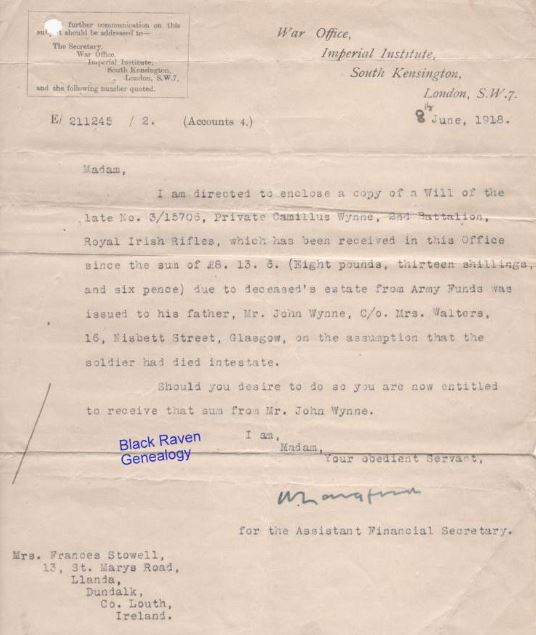
Camillus probably had no property of any value when he was killed. His whole estate may well have consisted of the eight pounds, thirteen shillings and six pence due to him by the Army in unpaid salary. When the War Office received a copy of the will in 1918, his salary had already been paid to his father, John. John Wynne, then a widower aged 67 years, was surprisingly found residing in Glasgow, Scotland, with a Mrs Walters. The letter the War Office then sent to Frances Stowell, to inform her of her entitlement, still survives in family-papers today.[3] 

Mrs. Francis (Wynne) Stowell, Dundalk
1918, Letter from War Office to Mrs. Francis Stowell

See also: Philip Camillus Wynne - Killed in Action in World War I  and Genealogy Saturday: Diary of a WWI Soldier's last days. 

[1] John McCrea, In Flanders fields, and other poems, New York, 1919, p. 3.
[2] Soldiers Wills, [Camillus] Wynne, National Archives of Ireland.
[3] Photograph of Camillus Wynne and Letter from the War Office to Mrs Francs Stowell, courtesy of Gabrielle, a Stowell descendant.  

………………. 
© 2014 Black Raven Genealogy

Saturday, 1 November 2014

The O’Connell Monument Fund and our ancestors

Peter Radcliffe, Contribution to the O’Connell monument, Dublin
Daniel O’Connell Monument, 
O’Connell Street, Dublin
In January 1863, Peter Ratcliffe of Malahide contributed two shillings towards the erection of the O’Connell monument in Dublin, and his name was printed in the newspaper.  This was probably my great-great-great-great-grandfather, born about 1797. He lived in Yellow Walls, Malahide, Co. Dublin until his death in 1887. Else, it was his son, also Peter (1833-1891), who was my great-great-great-granduncle. 

The public appeal for funds to erect a memorial to Daniel O'Connell, the Catholic Emancipator, was first advertised in the Freeman’s Journal in September 1862. Monies were collected from all over Ireland, as well as abroad. As was typical of the Victorian era, they even wrote a report about their endeavours. The Report of the O'Connell Monument Committee, was published in 1888 and is now freely available online.

A subsequent search of the Report for the period in early January 1863 revealed that Peter's two shilling donation was recorded there too, with his surname given as the more usual nineteenth-century variant, Radcliffe. The report provides a complete history of the origin and erection of the O’Connell monument in Dublin’s O’Connell Street. It also contains an appendix, listing, by location, all the subscribers to the monument fund, in chronological order, from September 1862 to July 1880. Thousands of names, addresses and sometimes occupations are listed  – a true Irish census substitute.

Malahide Subscriptions, O’Connell Monument Fund
The Report of the O'Connell Monument Committee (Dublin, 1888)

Names of the Malahide Subscribers to the O’Connell Memorial Fund, January 1863:
M. S. Hussey, Esq.; Rev. J. Gaffney, C.C.; Mrs. Davis; Mr. Thomas Gaffney; Mr. J. Archibald; Mr. John Gaffney; Mr. John Kindelan; Mr. Pat Gaffney; Captain Begg; Mr. Thomas Reynolds; Mr. Joseph Seaver; Mr. John Tierney; Mr. James Cave; Mr. Walter Cave; Mr. Peter Radcliffe; Mr. Richard Owens.

So, next time you walk by the O'Connell statue, you can think of Peter Radcliffe and our other ancestors from Malahide, whose contributions are included in the small sums amount of eighteen shillings and ten pence, and all our ancestors from across Ireland who contributed their pennies towards the cost of the monument. 

Sources: Freeman’s Journal, 3 January 1863; John O’Hanlon, The Report of the O'Connell Monument Committee (Dublin, 1888), p. 70.

……………….
© 2014 Black Raven Genealogy
Saturday, 25 October 2014

Murder in the family?

This is the tragic true story of two brothers, set in Victoria, Australia in 1895, which at the time received national newspaper coverage. The two young men, Thomas Radcliffe, aged 25, and Joseph Radcliffe, aged 23, were the sons of Thomas Radcliffe from Malahide, Co. Dublin and his wife Mary Minogue. Tom and Joe, as they were known, were first cousins of Anne (Radcliffe) Carroll, making them my first cousins four times removed.

No rumour of these remarkable events has survived in our family today. Perhaps this is not surprising - Australia is a long way from Dublin. Although, other myths relating to this family were remembered, in this case, one of the brothers lost his life and in Ireland, superstitions dictated that no ill be spoken of the dead, so all memory of the case was lost.

In the early 1890s, the brothers moved to a place called Waratah North, 100 miles from their home in Melbourne. There, they managed a cattle farm for their father. Waratah North was an isolated spot, near the southern-most tip of Australia. It was twelve miles from Fish Creek, a stop on the Great Southern railway line.  The brother’s nearest neighbour lived three miles away, at a place called Sandy Point.

According to newspaper accounts, ‘the brothers were well known and respected, and appeared to live together quite happily’. However, on the evening of 15 August 1895, they quarrelled and the next day Joe was found dead of a gunshot wound. To the surprise of the township, Tom was arrested on a charge of wilful murder and James Hannan, aged 18, who was employed by the brothers, was arrested as an accessory before the fact.

Upon hearing the shocking news of Joe’s death, his parents immediately came by train from Melbourne, bringing with them a doctor and solicitor.

On 20 August 1895, the Radcliffes buried their youngest son in Foster Cemetery, eighteen miles from Waratah North. The very next day they attended an inquest into his death, at which their other son was charged with his murder. Their grief must have been unimaginable.

The magisterial inquiry was held at Foster before a local justice of the peace and five jurymen and it was here that the extraordinary circumstances of Joe’s untimely death came to light.

Inquest into death of Joseph Radcliffe, Melbourne, August 1895, The Argus.
Inquest into death of Joseph Radcliffe, The Argus, 22 Aug 1895, p. 5

It transpired that Tom had gone into Fish Creek on Saturday, 10 August 1895. When he was still not home by the following Thursday, Joe became angry and rode out to look for him. The brothers somehow missed each other and when Joe got to Fish Creek, Tom had already arrived home. 

Joe then went home in a rage and a row ensued. In a fit of temper, Joe threw a kettle into the fireplace and hit Tom with a shovel. When Tom took the shovel away from him, Joe threatened to get the gun. Tom ran out of the house and Joe fired the gun after him, but Tom hid behind a tree. (Really, I am not making this up!). Joe then threw the gun at the doorway and it went off and then Joe fell on his back in the mud. James Hannan helped Joe to his bedroom and immediately left the house, for he was afraid of Joe.

Hannan then went to their neighbours, the Frasers in Sandy Point, where he spent the night. According to the Frasers, when he arrived, James told them Joe had shot himself but ‘was only putting it on and was not so badly hurt as he pretended.’ Tom then arrived at the Frasers saying ‘It’s a bit rough. He’ll pay pretty dear for this lot. I won’t have anything more to do with him.’ However, the following morning they returned to the farm and found Joe dead. Tom sent a telegram to the police and to his father.

Edwin Wiles gave evidence that Joe had come to his hotel in Fish Creek looking for Tom and became angry when he learnt Tom had met their father at Boys railway station and had gone with him to inspect some land. Wiles said Joe was bad-tempered and ‘always the aggressor’ in any altercation, while Tom was ‘exceptionally good-tempered, especially with his brother’. Even Thomas Radcliffe, father of Tom and Joe, gave evidence that Tom was ‘exceptionally quiet in temperament’, unlike Joe, who had a ‘hasty disposition’ and ‘having been delicate when young was permitted his own way by all the brothers’.

The medical evidence corroborated the account heard.

The jury found that Joe had died from a gunshot wound, accidentally self-inflicted and Tom and James Hannon were discharged.

So, what do you make of that?

Sources: Launceston Examiner, 22 August 1895, p. 6; The Argus, 21 August 1895, p. 6 and 22 August 1895, p. 5; Portland Guardian, 23 August 1895, p. 3, all accessed on Trove.

………………
© 2014 Black Raven Genealogy

Saturday, 18 October 2014

Our family history: Joseph Wynne

Surprisingly, or maybe not, quite a number of my ancestors are recorded in nineteenth-century Irish prison records.  Some were locked up for more ‘romantic’ crimes relating to the struggle for Irish independence, but more often than not it was for petty offences like being drunk in public.  Luckily for us, the prison registers are packed full of genealogical information that would not otherwise have survived and this is why you keep hearing about our family’s historic misdeeds. It is not that ours was a particularly villainous family ­- it just did not take much to fall foul of the law back then. 

In March 1902, my great-granduncle Joseph Wynne, then forty-seven years of age, faced a seven day prison sentence, just for getting drunk. He did not actually do anything else wrong, apart from showing his face in public, having had one (or probably more) too many. Joseph served his time in Dublin’s Mountjoy Prison, rather than pay the extortionate ten-shilling fine. 

The register for the prison confirmed Joseph was born in Thomas Street, Dublin, in about 1855 and while no record of his baptism has been located, this address is in keeping with what is already known about our Wynne family. John Wynne and Bridget Hynes, Joseph’s parents, lived in Thomas Street from the time of their marriage in 1849, until the 1870s.  

Joseph Wynne (c1855-1910), Mountjoy Prison Register, 1902
Joseph Wynne (c1855-1910), Mountjoy Prison Register, 1902
(Click on page to enlarge)

Joseph was described in the prison register as being five feet five inches in height and weighing 168 pounds. He had brown hair, grey eyes and a fresh complexion, with no distinguishing marks. Joseph was a brush-maker by trade.

Strangely, Joseph named Patrick, his younger brother and my great-grandfather, as his next of kin, even though their father John was still very much alive at the time. Joseph was also recorded as being a widower.

Ten years earlier, on 10 September 1892, Joseph had married Katie Hosborough in St. Kevin’s church, Harrington Street. He was nearly twenty years older than Katie. Tragically, two years before Joseph was arrested for drunkenness, Katie died at Holles Street Hospital, a maternity hospital in Dublin city. She was only about twenty-six years old when she died of syncope, supposedly a transient loss of consciousness, but one she suffered for eleven days before her death. Sadly, there is no record of any surviving children from their marriage.

Joseph died of phthisis (T.B.) on 22 October 1910 in Jervis Street Hospital.  His last address was 9 Kings Inns Street. His brother Patrick organized his interment in the St Paul’s section of Glasnevin Cemetery.  

When my great-grandfather organised the burial, the cemetery recorded his residential address as 9 Kings Inns Street, the same address as Joseph. Patrick was by then married with two children and registered as the ‘inhabitant householder’ at 16 St James’s Avenue, off the Clonliffe Road. This was the family’s home when his son Brendan was born in April 1908 and when my grandfather Kevin was born in December 1909.  It is therefore somewhat surprising to see Patrick residing in Kings Inns Street and not in Clonliffe Road. This is especially so as, six months later, on the night of the Irish census, Patrick was again recorded as living separately from his wife, Teresa. He was lodging in Cork city, when Teresa (Carroll) Wynne and their children were visiting her mother in Dublin.  Patrick was known to have travelled to Melbourne, Australia shortly thereafter, without his young family, and resided there for some years between 1911 and 1915. I wrote about this hereSo, did Patrick move in with Joseph, solely to take care of him during his illness?  Was it merely convenient to provide one single address to the cemetery, when organising Joseph’s funeral? Or, could Patrick and Teresa have been living separately in 1910 also?  

Sources: Prison registers 1790-1924, FamilySearch index; Irish Prison Registers 1790-1924, Findmypast; Copy marriage and death registers, General Register Office; Burial register for Glasnevin Cemetery, Glasnevin Trust. Dublin City Electoral Lists 1908-1912, 1915. 

……………….
© 2014 Black Raven Genealogy

Saturday, 11 October 2014

Sepia Saturday: Horses and Mischief

Sepia Saturday prompts bloggers to share family history with old photographs.


Their suggestion this week features an old horse-drawn carriage, with its mischievous coachmen seemingly playing for the camera, while they wait to collect their passengers. The themes of horses and mischief reminded me of the following picture-postcard of Maurice Carroll, so I thought it might be suitable for my first Sepia Saturday venture. Maurice was a first cousin of my grandfather, Kevin Wynne.

Maurice Carroll, Barry Buddon training camp, 1911

Maurice Joseph Carroll, named after his paternal grandfather, was born in Dublin city on 13 November 1887, the eldest son of James and Anne (Molyneux) Carroll. The family migrated to Newcastle-upon-Tyne, England in the early years of the twentieth century, when Maurice was still a young teenager.

The biggest employer in the area they lived was Sir W. G. Armstrong Whitworth & Co. Ltd, a large manufacturing company, based in Elswick. By 1911, Maurice was employed there, as a joiner in their ship building division, while his brother James was an apprentice electrician in their gun factory.

Maurice J. Carroll (1887-1964)

Maurice volunteered at the Elswick Battery of the Royal Horse Artillery, a territorial unit based in Newcastle, composed of men from the Armstrong Whitworth factory. The battery had been established in 1900 and the regiment fought in the Boer War. Maurice received his training at the Barry Buddon Training Camp in Angus, Scotland in 1911 and this is where the photograph of Maurice, on his very handsome army horse, was taken. It is unlikely that Maurice actively served in the First World War, as Armstrong Whitworth made weaponry and the work of its employees in the factory was probably deemed more important to the war effort.

Maurice sent the Barry Budden postcard to his friend and future brother-in-law, and given he lived in the urban district of Benwell in Newcastle, the message written on the back reveals his true sense of mischief.


‘Dear Eugene, just a line hoping you are keeping well, as I am very well myself. What do you think of this horse of mine. I am going to bring him to Benwell. Do you think I will be able to get room in the garden for a stable for him. I hope you will have one ready by the time I come home for he will be tired and will want a sleep. Best love from M. J. Carroll, 1st NRFA [Northumbrian Royal Field Artillery].’


In December 1915, Maurice married Eugene’s sister, Mary Agnes Leckey, at St Joseph's Roman Catholic Church in Benwell. The couple went on to have four children, two boys and two girls. 


Mary Agnes (Leckey) Carroll with her youngest son 

Maurice remained in Newcastle for the rest of his life.  


Maurice J. Carroll sitting front left, with friends

He certainly appears to be having a fun time with his friends in the above picture also. Out together for the afternoon, minus the horse, they look like a bunch not opposed to a bit of devilment!

Check out how other 'Saturday Sepians' interpreted this week’s prompt here

Sources: Church records on Irishgenealogy; 1911 Census of England and Wales on Ancestry; Free BMD; Images and family lore courtesy of the Jones family of Newcastle, descendants of Maurice Carroll.

……………….
© 2014 Black Raven Genealogy

Saturday, 4 October 2014

Petition for clemency signatory, John Wynne

The very earliest mention so far found of my great-great-grandfather, John Wynne of Thomas Street, was as a signatory to a petition for clemency, in 1848.

This petition was for William Smith O'Brien, an Irish nationalist, who led a rebellion in Co. Tipperary in August 1848, for which he was arrested and found guilty of high treason. His death sentence caused great upset in Ireland and by May 1849 over 80,000 signatures requesting clemency had been collected, most of them in Dublin.

William Smith O’Brien Statue, O’Connell Street, Dublin

It is only John Wynne’s relatively uncommon surname, in addition to collaborating evidence proving his Thomas Street address, which permits any level of certainty that this was our John Wynne who signed the petition.

Unfortunately, the image of my great-great-grandfather’s signature was not made available online. I would have dearly loved to see it, and compare it to the signature on the 1901 Census, but the original documents, held on a roll in the National Archives, have since been withdrawn from public use. Nevertheless, at least we now know that John Wynne of Thomas Street signed the petition and lived in Dublin city before his marriage to my great-great-grandmother, Bridget Hynes, on 16 September 1849.

John was also recorded in an extract of the 1851 census, living at 56 Thomas Street, in the parish of St. Catherine, in Dublin’s ‘South City’.  The census itself perished during the Civil War. Luckily, a man called Dr David Chart had already created an extract of the 60,000 ‘heads of households’ in Dublin city and it is  available in the National Archives.  The city directories for this period generally only included rate-payers, so the extract provides another fortuitous record of my great-great-grandfather.

Extract 1851 Census, Jno Wynne, Thomas Street, Dublin (NAI, MFS 50, p. 552)

Admittedly, the extract does not make up for the destruction of the census itself. It contains no mention of those living with John and does nothing to further my search for his parents. I know this record relates to my John Wynne because his address, 56 Thomas St., was also the address recorded at the baptism of his son James in 1857. The extract has thus helped pinpoint his location six years earlier than James’ birth and shows John Wynne’s attachment to the Thomas Street area. It has added to what I already know and helped identify John in the William Smith O’Brien petition.

Absolutely nothing about John’s life prior to this has yet been uncovered!

Sources: The William Smith O’Brien petition index and the 1851 census extract are now available on the subscription web-site FindmyPast. 


……………….
© 2014 Black Raven Genealogy