Saturday, 30 May 2015

Genealogy Saturday: Evidence or coincidence?

In genealogy, we often seek out patterns to further our goals. We use naming patterns to help predict grandparents' names, and migration patterns to identify potential places of origin. But sometimes, as humans, we observe patterns where they do not in fact exist – we see a face on the moon, animals in the clouds, and occasionally even hear voices in the breeze. Sometimes this works in our favour. Sometimes it leads us down false paths. And, sometimes it’s hard for a genealogist to tell the difference.

Recently, I learnt William and Hannah Daly were the parents of my third great-grandmother, Jane (Daly) Byrne. Hannah's maiden name was not revealed.

Richard Daly's parents were also named William and Hannah Daly. Richard was born in Spring Gardens, Dublin, in December 1818 and my hunch is he was Jane's brother. When he married Sarah McGrane, his mother's maiden name, and potentially that of my fourth great-grandmother, was confirmed as ‘Dillon’.

There is nothing to prove Richard and Jane were siblings. All I can do is check the surviving documentation for any sign of a relationship between the two.  Yet, even this is complicated!

First, Richard's wife Sarah and my second great-grandmother, Margaret McGrane, were sisters and Margaret was married to Jane's son, Francis Byrne. So, in proving a relationship between the Byrnes and the Dalys, I have to be mindful of this McGrane connection. Secondly, in the 1870s, Jane and Richard were neighbours in Upper Jane Place, Dublin, which could be indicative of a familial relationship, but might also, in itself, account for any perceived relationship between the pair.

Nevertheless, there is some evidence of a pre-McGrane relationship between the Dalys and the Byrnes:-

Francis and Margaret (McGrane) Byrne lived with Richard Daly at 18 Upper Jane Place, in November 1879, when their daughter, Margaret, was born. Richard and Sarah were married over three months by then, so it could be argued they were staying with Sarah and this was a McGrane connection.  

But, and I missed this initially, the Byrnes were also living with Richard Daly when their infant son, Charles, died in April 1879, three months PRIOR to Richard and Sarah's marriage. Now, it could be argued, there was a pre-exiting connection between the Byrnes and the Dalys, one that might even have led to the incongruous match between the seventeen year old Sarah and the sixty year old widower, Richard.

So, as Francis Byrne's grandparents were William and Hannah Daly, and as Richard Daly’s parents were William and Hannah Daly, and as Francis was living with Richard, it's quite easy to surmise he was living with his uncle. Right? Else, it was an amazing coincidence!

Separately, William Daly, Richard's father, died on 27 July 1876, at 18 Upper Jane Place. Copy death registers in Ireland were not usually very informative, genealogically speaking, except they did record the name of the informant, and that person was often a relative. My hope, when I ordered a copy of William's death register, was the informant would be named as ‘Jane Byrne, daughter’, and I would have the ‘proof’ I needed. Ha!

That was too much to ask for, but the answer was probably better than I expected. The informant was Catherine BYRNE of 16 Upper Jane Place. Catherine was present when William died. Jane (Daly) Byrne's youngest daughter was named Catherine. She was fourteen years old at the time. Is this another amazing coincidence?

Or, was it a coincidence at all?

Would a mere neighbour have been with William in his final hours?  - ok, maybe she would, if she had ‘nursing’ experience. But, would she have registered his death?

Looking at the copy death registers obtained in respect of all my direct ancestors, unless they died in a hospital, ALL the informants were close family members of the deceased. Sometimes their relationship was stated and sometimes it was not. Yet, the most distantly related informant in my family was a son-in-law and he had been living with the deceased. Based on this, the chances are Catherine and William were closely related.

The relevant legislation for registering deaths in Ireland was introduced in 1864 and the responsibility for completing the task fell to ‘some person present at the death’ or ‘the occupier of the house or tenement in which the death took place.’ So, a neighbour, if present at or around the time, might have registered his death, even if this did not normally happen in practice.[1] 

It is interesting to note though, an amendment to the legislation in 1880, within four years of William's passing, made it a requirement, in the first instance, for the informant to be ‘the nearest relatives present at the death.' Failing this, the responsibility next fell to ‘every other relative of the deceased dwelling or being in the same district as the deceased’.[1]
 
So, on the balance of probabilities, it would seem the informant, Catherine Byrne, was a close relative of William. And, since our Catherine Byrne's grandparents were William and Hannah Daly, we might easily conclude this William was her grandfather and her grandmother, my fourth great-grandmother, was his wife, Hannah Dillon. 

Or, and my fear is, looking at anything long enough might cause such analogies to appear and I might be seeing patterns that do not actually exist.

Our ancestral path to William and Hannah Daly

[1] Source: The Registration of Births and Deaths (Ireland) Act, 1863 (Part III, Section 36); Registration (Ireland, Amendment) Act, 1880 (Section 10), accessed HISTPOP

Other posts in this series:

    .…………….
    © 2015 Black Raven Genealogy

    Saturday, 23 May 2015

    Genealogy Saturday: Where there's a will…

    This week, I learnt something new about my great-great-grandmother, Anne (Radcliffe) Carroll. In the numerous records of her life, from the day she married until the day she was buried, she went by the name ‘Anne’. It now transpires her given name was actually Hannah Anne. I have to say, this new finding inspires renewed hope that one day I might also discover who her mother was.

    Hannah Anne Carroll, Probate 1919, Dublin.*

    Anne was born about 1849, but we don't know much about her early life. Her earliest confirmed record was dated August 1869, when she was said to have been twenty years old and marrying Maurice Carroll, in Swords, Co. Dublin. Her father was named as John Radcliffe and her mother as Mary. ‘Mary’ is not much to go on in a country so dedicated to the Virgin Mother!

    When Anne was about eight years old, her father left Ireland for Melbourne, Australia and Anne probably never saw him again. He married Bridget Flanagan in Melbourne in 1861. Their marriage register confirmed his first wife had died in 1853 and he had but one surviving child. 

    Anne may well have spent her younger years in Yellow Walls, Malahide, where her father's family were from. She was living there at the time of her marriage and maintained close ties with her friends in Malahide, even after the Carrolls moved to Dublin city. She may have been raised by her paternal grandparents, Peter and Anne Radcliffe, though we may never know for sure. Her mother's family might also have lived nearby.

    Anne's grandmother died the week before Christmas in 1866 when she was about seventeen years old, only two months after her father had passed away in Australia. She was close to her uncles Peter Radcliffe and Joseph Radcliffe, who also lived in Yellow Walls, for they each sponsored the baptism of one of her two eldest children.

    Anne is a derivative variant of the name Hannah, so it strikes me as a little odd for both names to have been given to the same child. Perhaps it was a deliberate attempt to honour two separate women – both her grandmothers. Anne's paternal grandmother was called Anne so maybe Mary's mother was called Hannah.

    This new piece of information came to light when I obtained a copy of Anne's last Will and Testament, written in December 1918, seven days before she died. It is the earliest dated Will so far obtained in respect of any of my direct ancestors; basically, those who went before her had no real property to worry about. The extent of Anne Carroll's estate, on the other hand, came as something of a surprise.

    Anne (Radcliffe) Carroll’s Will
    I, HANNAH ANNE CARROLL of 20 North Gloucester Place, Dublin, Widow, declare this to be my last will.
    I hereby devise and bequeath to my daughter Mary Carroll absolutely all my real and personal estate including my house No. 21 Upper Rutland Street, Dublin and all furniture and effects in my residence No. 20 North Gloucester Place, and my interest in a policy on the life of my uncle [Joseph] who died recently. And I appoint the said Mary Carroll sole executrix of this my Will IN 
    WITNESS whereof I have hereunto signed my name this sixteenth day of December one thousand nine hundred and eighteen.
    [signed]: Anne Carroll
    Signed by the testatrix Hannah Anne Carroll as her last Will in our presence who in her presence at her request and in the presence of each other have hereunto subscribed our names as witnesses.
    [witnessed]: George Wheeler
    86 Merrion Square, Dublin
    Solicitor

    [witnessed]: R. J. Simpson
    53 [maybe Fitzroy Avenue]
    Drumcondra, 
    Dublin.
    Our Radcliffe Pedigree 


    Source: *Hannah Anne Carroll, 1919, Dublin, ‘Calendars of Wills and Administrations, 1858 – 1922’, National Archives of Ireland; Copy will of Hannah Anne Carroll, 1919, Dublin, National Archives of Ireland.


    .……………. 
    © 2015 Black Raven Genealogy

    Saturday, 16 May 2015

    Saturday's Genealogy Story: Our Family in Crisis

    My great-great-grandfather, John Donovan, spent the last eleven days of his life in the North Dublin Union Workhouse, possibly in the infirmary, before dying of tuberculosis on 20 August 1875. When first discovered, this was the single saddest revelation of my genealogy research and really drove home just how hard life was for our ancestors.  But, the predicament the Donovan family found themselves in, in 1875, was even worse than I had imagined then. This was truly a family in crisis.

    According to his death register, Thomas Donovan, the man I suspect was John’s father, also died in the North Dublin Union Workhouse, just a few months after John. But, unlike John, I found no trace of Thomas in the workhouse admission register, when I searched it on microfilms at the National Archives. And, one day last year, I searched for Thomas until my head hurt, watching the pages whiz across the screen, trying in vain to find any mention of his name.

    Now, these registers have been digitised and made available online and the admittance record for Thomas was instantly apparent.  Aged eighty-five years on 20 March 1875, Thomas Donovan, a widower, was admitted to the workhouse, where he was to die of ‘debility’, some months later, on 13 October 1875. His admittance set in motion a chain of events that had devastating consequences for his family.

    Thomas entered the workhouse just one month before John Donovan was convicted of larceny. John was then sentenced to serve six months hard labour in the Richmond (Bridewell) Penitentiary. The date Thomas entered the workhouse provides a likely explanation as to why my great-great-grandfather was tempted to commit such a crime. It is not hard to imagine him being desperate to provide for his aged father in the final months of his life and maybe feeling he had no alternatives, especially as it turns out John himself was terminally ill.

    As it now transpires, Thomas was not the only member of the Donovan family to suffer when John was imprisoned. John’s wife died of tuberculosis two years previously, but the newly indexed records revealed an Alice Donovan entered the workhouse on 28 April 1875, the week after John’s arrest. Alice was a spinster and worked as a servant, though her clothes were described as ‘bad’ when she entered the workhouse.

    Alice was of the right age to have been John’s sister. He was forty-nine years old at the time, while she was said to have been fifty. Maybe they were not siblings, but they were likely closely related, for they lived together in the same house. Alice was living at ‘121 L[ower] Gloucester Street’ at the time she was admitted to the workhouse, and John’s address was given as ‘121 L Gloster Street’ when he was arrested, both spelling variations for the same place.

    This was seemingly the Donovan family home around this time. John’s daughter, Mary Agnes Donovan, lived at 121 Gloucester St L when she married my great-grandfather, Charles O'Neill, in April 1874. Thomas lived at number 95 L Gloucester Street when he entered the workhouse. Three days after his admittance, Mary Agnes gave birth to her first son at number 116, just a few doors down. It’s hard to believe the similarity of all their addresses was pure chance.

    Alice presumably lost her home when John was arrested and had nowhere else to go. I don't know if she was sick at the time, but she never did get out of the place. The poor woman lived in the awful conditions of the workhouse for a year and ten months before her death, on 22 January 1877.  Although, John's prison sentence was reduced, by order of the Lord Lieutenant, he died in the month following his release and never got a chance to re-establish his household.


    From a map of Dublin City, 1885* 

    Source: Thomas Donovan, 1875 and Alice Donovan, 1875, Poor law records of North Dublin Poor Law Union, 1840-1918, workhouse admission and discharge records, Book 29 (18 January 1871) Book 32 (10 May 1875), item 4, FindMyPast (subscription site),  citing 'Register of admission and discharge of the North Dublin Union Workhouse', NAI/BG/78/, National Archives of Ireland.

    * Excerpt from the Map of Dublin City, 1885, courtesy of www.swilson.info/

    Previous posts of relevance:


    .…………….
    © 2015 Black Raven Genealogy

      Saturday, 9 May 2015

      Newspaper archives - A genealogy goldmine

      James and Lena (O'Neill) Byrne, 
      Malahide, Co. Dublin, 1934

      When Lena (O'Neill) Byrne, my paternal grandmother, died in October 1956, her funeral notice in the Sunday Independent proclaimed she was ‘deeply regretted’ by a ‘sister and brothers’. I know Lena was the youngest child of nine, yet, I could not identify which of her siblings survived her passing.  

      So, I've spent my free time this week trying to plug the gaps, and although ‘O'Neill’ is one of those impossibly common surnames in Ireland, I'm getting there, bit by bit, partly with the help of family newspaper announcements (thanks to a recent three day free trial with the Irish Newspaper Archives).* 

      Lena's four Sisters
      Lena's sisters, Teresa (Aunt Tess) and Johanna Mary (Aunt Joan) O'Neill, both predeceased her, by five years. Aunt Tess married a widower, Richard Greer, in 1928 and lived in Drumcondra, Dublin.[1]  One of her step-daughters, Mary Greer, was Lena's bridesmaid, when she married my grandfather. Aunt Tess died on 1 August 1951 and was buried in Glasnevin Cemetery.[2] Aunt Joan married Jack Lockhead in England, in 1924, and seemingly also died in 1951, in England.[3]

      Lena's eldest sister was baptised Mary Catherine O'Neill, in Westland Row, on 25 August 1876.[4] Mary is not remembered in our family today and no further trace of her has been found; she may have died in childhood, hence the name Mary being used again, when Mary Agnes was born.

      Known as ‘Aunt May’, Mary Agnes (O'Neill) Pyke was the wife of Robert Pyke, and the mother of the illustrious Bobby Pyke.  She died, aged seventy-five years, on 24 May 1960. So, at the time of Lena's death, Aunt May was her sole surviving sister.
       
      Mary Agnes (O'Neill) Pyke, Obituary,
      Irish Independent, 25 May 1960, p.1.

      Lena’s Four Brothers
      Lena's eldest brother was Charles Joseph O'Neill, born on 23 March 1875, and baptised in St Mary’s Pro-Cathedral. So far, only his birth and baptism records have been identified, and like Mary Catherine, he is no longer remembered in our family and likely died before Lena.[5]

      Uncle Artie was definitely one of the brothers to survive Lena's passing as he lived in London until 7 January 1965. This leaves Uncle Jack, only remembered as having had a family, and Uncle Rob, who it is thought might have lived in Navan, Co. Meath. 

      John O'Neill (Uncle Jack) was born on 29 September 1879, at Queens Square, Dublin.[6] He became a house-painter and in 1901 married Lillian O'Grady, an Irish girl, born in Liverpool.[7] They went on to have a string of children and lived in Lower Dominick Street in Dublin City until, at least, the early 1940s, when the area became severely run-down.[8] The record of John's death has, so far, remained hidden, probably in plain sight among the myriad of others named John O'Neill, who died in Dublin.

      Uncle Rob, or Robert Joseph O'Neill, to give him his full name, was born at 2 Bath Street, in Dublin, in 1878.[9] In 1901, he also worked as a house-painter and lived with his mother and step-father.[10] There was no sign of him in Dublin in 1911, and when I searched the census for Navan, I came across a Robert O'Neill, of the right age, an insurance agent, living with wife Bridget, son Robert and three step-children.[11] Could this have been my missing granduncle?

      Next, I found a newspaper obituary for a Robert O'Neill, who died in Navan on 31 January 1957, and, although it contains no mention of Bridget, it most definitely features my granduncle.  

      This is one of those local newspaper obituaries every family historian dreams of finding. It provides a biography of Robert's life, which you can read below, but more significantly, it lists the chief mourners at his funeral. Starting with his wife and children, there follows a list of people, who taken together, provide absolute proof of his connection to my grandmother:  
      ‘Mr. Arthur O'Neill, England (brother); Mrs. May Pyke, Dublin (sister); Mr. Robert Pyke, Dublin, Mr. Richard Greer, Dublin and Mr. James Burne, Malahide (brothers-in-law) and Mrs. L. O'Neill, Dublin (sister-in-law).’

      Ok, they spelt my grandfather's name wrong - Lena's widower, one of Robert's brothers-in-law, was James Byrne of Malahide, not James Burne - but nevertheless, this answers most of my questions!


      Robert O’Neill, (1878-1957), Dublin, Navan
      Robert O'Neill, (1878-1957),
      Obituary, Meath Chronicle, 9 February 1957, p. 6.


      If you are descended from anyone mentioned in this post, it would be great to hear from you!

      * Note: If anyone else is tempted by the Irish Newspaper Archive's offer, don't forget to cancel the auto-renew setting, unless you want the free trial to convert into a paid monthly subscription.


      [1] Copy marriage register, General Register Office.
      [2] Copy burial register, Glasnevin Trust.
      [3] Free BMD, BMD index for England and Wales.
      [4] Church Records, index and images, IrishGenealogy.ie; Copy birth register, GRO.
      [5] Same.
      [6] Same.
      [7] Church Records, index and images, IrishGenealogy.ie.
      [8] Civil records, index, IrishGenealogy.ie (accessed July 2014); John O'Neill, 1940-41, Rotunda unit, ‘Dublin City Electoral Lists 1938 to 1964’, Libraries and Archive, Dublin City Council.
      [9] Church records, index and images, IrishGenealogy.ie; Copy birth register, GRO.
      [10] Ellis household, Mountjoy, Dublin, 1901 Census of Ireland, National Archives of Ireland.
      [11] O Neill household, Ardbraccan, Meath, 1911 Census of Ireland, National Archives of Ireland.


      .……………. 
      © 2015 Black Raven Genealogy

      Saturday, 2 May 2015

      Granny’s obituary

      Well, it's happened again! Each and every time I attempt to spend any time researching my father's family history, my mother’s side clamours for the return of my attention. Last month, I'd only just started, by investigating what happened to Dad's maternal Uncle Artie, when my maternal Byrnes dangled the carrot of some previously unknown fourth great-grandparents in front of me. And, of course, I took the bait. Who wouldn't? After all, there is nothing better than having a genealogy brick wall come tumbling down, but, I'm back on the trail of Dad's lineage again now.

      Newspapers are my all-time favourite genealogy resource. They are so full of fascinating stories about our ancestors' lives, and often contain details not available anywhere else. Regrettably though, in Ireland, it was the mid-twentieth century before most of my ancestors started gaining any column inches. Yet, when the Irish Newspaper Archives recently announced their three-day free-trial, I knew I had to take advantage of it. And this week, I signed up.* 

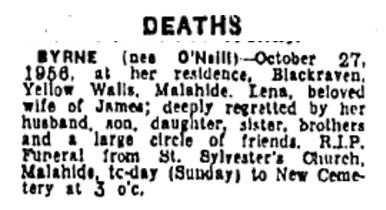
      First off, I searched for information about my paternal grandmother, Lena (O'Neill) Byrne. I know so very little about Lena and her eight identified siblings. Unfortunately, she didn't make the papers until her death from breast cancer, in October 1956, when her family inserted a notice of her funeral:

      https://blackravengenealogy.blogspot.com/
      Lena (O'Neill) Byrne (1895-1956),
      Sunday Independent, 28 October 1956, p. 7
      'BYRNE (nee O'Neill) – October 27, 1956, at her residence, Blackraven, Yellow Walls, Malahide. Lena, beloved wife of James; deeply regretted by her husband, son, daughter, sister, brothers and a large circle of friends. R.I.P. Funeral from St. Sylvester's Church, Malahide, today (Sunday) to New Cemetery at 3 o'c.'

      It was more than likely my Aunt Maisie, Lena's only daughter, who organised this announcement in the newspaper. She provided the date of death as 27 October.  The following week, on 2 November, Maisie also registered her mother's death with the civil authorities, but this time gave the date of death as 26 October. I'm now not fully sure which day she died; maybe she died overnight on the Friday night / Saturday morning.

      The month after the funeral, my grandfather, aunt and father, also inserted an acknowledgment in the newspaper, thanking those who cared for my grandmother during her final illness and comforted them in their grief when she died:

      https://blackravengenealogy.blogspot.com/
      Lena (O'Neill) Byrne (1895-1956),
      Sunday Independent, 18 November 1956, p. 9
      'BYRNE, (nee O'Neill) - The husband and family of the late Helena (Lena) Byrne, "Blackraven", Yellow Walls, Malahide, wish to thank most sincerely all those who sympathised with them in their recent sad bereavement, those who sent Mass cards, letters, telegrams and flowers, and all who attended the removal of the remains, Mass and funeral. A special word of thanks to Rev. Fr. Boland, Nurse T. Stroker and Dr. J. Bell, also kind neighbours. Hoping this will be accepted by all as a token of deep appreciation and gratitude.'

      On the second and third anniversaries of Lena's death, her family placed and an ‘In Memoriam’ notice in the newspaper. Here's the one for 1958:

      https://blackravengenealogy.blogspot.com/
      Lena (O'Neill) Byrne (1895-1956),
      Irish Independent, 27 October 1958, p. 1
      'BYRNE (Second Anniversary) - In loving memory of my dear wife Helena Byrne, late of "Blackraven", Yellow Walls, Malahide, who died Oct. 27, 1956. Masses offered. Will those who think of her today, a little prayer to Jesus say - inserted by her loving husband and family.'

      According to the death notice in 1956, Lena was ‘deeply regretted’ by her ‘sister and brothers’. I know her brother Artie was alive and well and living in London in 1956. I also know, her sister Tess (O'Neill) Greer predeceased her, and was buried in Glasnevin Cemetery in 1951, but I do not know what happened to Lena's six other siblings. 

      Guess, it's high time to find out!

      * Note: If anyone else is tempted by this offer, don't forget to cancel the auto-renew setting, unless you want the free trial to convert into a paid monthly subscription.

      .……………. 
      © 2015 Black Raven Genealogy 

      Friday, 24 April 2015

      Genealogy Arbor Day ~ A typical Irish family tree

      On Arbor Day, from the Latin Arbor, meaning tree, trees (as in the green leafy ones) are celebrated all over the world. In the U.S., Arbor Day falls on the last Friday in April, and this year, Colleen of the genealogy blog Leaves & Branches suggested we celebrate our Genealogy Tree on Arbor Day

      The Tree Council of Ireland organises National Tree Week in March each year and Tree Day is celebrated each October, but, we do not have Arbor Day, as such. Nevertheless, I thought I would participate in Colleen’s meme today and share some general information about our genealogy family tree.
      Our Family Tree Size
      Currently, there are 920 individuals in my genealogy tree – a fairly modest number by most international standards.  Serious genealogists, especially those with deep roots in the U.S., often count their ancestors in the tens of thousands, but 920 is probably a fairly average size for a native Irish tree. The renowned genealogist, John Grenham, recently admitted he had a ‘piddling 600’ people in his tree, and he has being researching far longer than I have.[1]

      Included in the tree, are my direct line ancestors (maternal and paternal), their siblings, and their siblings’ spouses and children. Researching the whole family like this helps to build a more colourful picture of our ancestors’ lives. Plus, it is often essential to piece together all the snippets of information available for each sibling, before the names of their parents finally become apparent.


      Our Family Tree Score
      In order to determine the dimensions of my genealogy tree, I counted the total number of direct ancestors in each generation, starting with myself, i.e. two parents, four grandparents, etc. Next, I counted how many of them, in each generation, I had identified.  Then, I charted the results, below, adding the percentage number of direct ancestors identified, to give a ‘tree score’. There was a bit of maths involved, but I am an accountant after all.


      The tree score for eight generations is 23 per cent, meaning I know the names of less than a quarter of my ancestors, up to and including my fifth great-grandparents. This includes some 'grandmothers', where only their given names are known and their maiden names are still awaiting to be discovered. So, there is still quite a bit of work to do! 

      When Crista Cowan of the Ancestry blog similarly calculated her ancestral number, in 2012, she based it on ten generations, not eight as I have done.[2] Each generation you go back doubles the number of ancestors, (everyone has two parents), so in ten generations, you have 1022 direct ancestors. But, I know the names of nobody in the two additional generations, so our tree score reduced to just 6 per cent. As only two of the 128 fifth-great-grandparents have been identified and as it’s unlikely the names of many others will ever come to light, eight generations is probably far more reasonable, for a native Irish tree. Why depress myself for not meeting someone else’s potential?


      Our Deepest Roots
      Our deepest roots currently belong to the Radcliffe family from north County Dublin. Peter Radcliffe was my fourth great-grandfather from Malahide. He was likely baptised ‘Peter Ratty’ in the parish of Baldoyle, on 25 November 1798, the son of Thomas Ratty and Mary Cullen, and as such, Thomas and Mary are the two fifth great-grandparents in the chart above.


      [1] ‘Irish Roots: The Other Clare Roots’, The Irish Times, 13 April 2015.
      [2]  'Family History All Done? What’s Your Number?', Ancestry blog, 16 August 2012.

      Images: Some old beech trees in the back paddock, Co. Kildare.


      .……………. 
      © 2015 Black Raven Genealogy
      Saturday, 18 April 2015

      Catharine Byrne, a ‘fallen’ woman?

      My third great-grandparents, Francis and Jane (Daly) Byrne had five children that I know of. Their son, Francis, my great-great-grandfather, lived and died in Lower Jane Place, Dublin and their daughter, Hannah (Byrne) Comiskey, emigrated, spending her last forty years in New York. But, prior to the 1901 Census in Dublin, I lost track of the other three. They were named Charles, Jane and Catharine Byrne.

      Buoyed by the recent success at finding a record of my third great-grandmother's death in Brooklyn, I hoped to now pick up the trail of her missing children in New York City. I knew from Jane's obituary, in 1901, she was survived by two daughters and one son.  It was this genealogical quest that has yielded my latest, perhaps somewhat polemic, discovery.

      I came across the marriage of Katherine Byrnes and Charles Carroll, on 27 February 1920, in Manhattan. Ignoring spelling variations in favour of phonetic pronunciation, Katherine seems a likely contender for one of my missing great-great-grandaunts, Catharine Byrne.  This lady was also born in Dublin and her parents were named as Frank Byrnes and Jane Daly. Charles Carroll was a widower, the son of Charles Carroll and Sarah McDonald.

      Everything fit, apart from Katherine’s stated year of birth –1875. She was said to have been born fourteen years after our Catharine Byrne, who was baptised in O’Toole's parish in Dublin in January 1861. But, that didn't put me off, much; this family were notoriously inaccurate when reporting their ages, especially as their years progressed. Plus, back then, it might have been very difficult to admit to being fifty-nine years old at your first marriage – better to have only been only forty-five. You may think fifty-nine sounds just plain ‘too old’ for a first marriage back then, but bear with me.

      The 1920 US Federal Census, showed Charles E. and Catherine Carroll, living together as a married couple, at 405 82nd Street, Manhattan. There were also three adult children, John aged twenty-one, Charles aged twenty, and Francis aged eighteen years. Catherine was said to have been fifty-one years old, or born about 1868, here only seven years from the 1861 birth date of my great-great-grandaunt. Charles senior worked as a plasterer.  Initially, I thought he might have had the children with a former wife, who had since died. But, all was not as it first seemed.

      First, this census was enumerated on 17 January 1920, nearly six weeks before the marriage. Secondly, the birth registers for John, Charles and Francis, all born in Manhattan, confirm their mother was indeed Kat(i)e Byrnes, and not some former wife of Charles.

      Using the census records to trace the family backwards in time, they were all together in Manhattan, in 1910, but with an elder daughter, thirteen year old, Catherine, who was not with them in 1920. Catherine senior gave her birthdate as about 1866, getting ever closer to the actual birthdate of my great-great-grandaunt.

      In the 1900 census, the household included Charles and Katie Carroll, and their infant children Katie, John and Charles. Francis was not born until 1901. Katie senior’s birth date was given as January 1865, the same month as my great-great-grandaunt and now within only four years of her birth.  They said they were six years married, although no record of their marriage has been found in the New York City records. A birth record for young Katie, which, according to the census, occurred in New York in November 1896, has likewise not been located.

      Working forward from 1920, Catherine Carroll, the wife of Charles E. Carroll, and the daughter of Frank Byrnes and Sarah Daly, died on New Year’s Day in 1930.

      As you've probably guessed and while I've found no absolute proof, I'm thinking all these records relate to the same Charles and Catherine/Katie (Byrnes) Carroll. There may have been some impediment to their marriage, at least until 1920, but they lived together nonetheless. I'm also thinking that this might have been my great-great-grandaunt, although her mother was Jane Daly, not the Sarah Daly listed in the death register. I have an explanation for this ‘slip-up’ though; one of her children may have registered her death and confused the names of their grandmothers – remember, their paternal grandmother was called Sarah.

      Maybe Catherine and Charles merely lived together as husband and wife and did not legally marry, until 1920. It was presumably easy to pull this off in New York City, with its ever expanding population of new immigrants arriving from all over the world. If Catharine was deemed to have been a ‘fallen’ woman, it would certainly provide one explanation as to why her mother, a devout Irish Catholic, seemingly disowned her in 1900 and told the census enumerator she only had one child, her daughter Hannah, with whom she was then living.

      Of course, I may well have picked up the wrong end of the stick!


      ‘U.S. Patent D11023’ by Frédéric Auguste Bartholdi -
      licensed under Public Domain via Wikimedia Commons.  


      Main Sources

      • Catharine Byrne, 1861, St. Lawrence, Church baptism records, IrishGenealogy.ie
      • Katherine Byrnes and Charles Carroll, 1920, ‘New York, New York City Marriage Records, 1866-1938’, index, FamilySearch
      • Carroll Family, New York, ‘United States Census, 1900, 1910 and 1920', index and imagesFamilySearch / Ancestry.co.uk
      • Katherine Carroll, 1930, ‘New York, New York City Municipal Deaths, 1795-1949,' index, FamilySearch.


      .……………. 
      © 2015 Black Raven Genealogy