Saturday, 8 October 2016

James Wynne – a man of music

Blogging about your ancestors hugely increases the chances of connecting with their other descendants, and this year has been no exception. I love meeting new cousins and swapping ancestor stories with them. Plus, they usually have far more surviving family photos than my direct line.

And, so it was when I ‘met’ my third cousin from Australia. She’d gathered together quite a few tales about her great-grandfather, James Wynne. Like all family lore, these stories may have become a little distorted in the retelling, and they were likely prone to some exaggeration here and there, but undoubtedly they contained a kernel of truth, nonetheless.

James Wynne was my great-granduncle, born on 25 November 1857, in Thomas Street, Dublin city. He worked as a brush-maker, probably at the Varian Brush Factory in Talbot Street, just like most of his brothers. In 1892, he married Christina Kavanagh and together they had five children - John Augustin, Nora Isabel, James Percival, Moira J, and Edward Patrick.
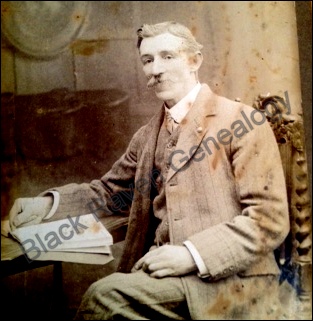
Supposedly, James Wynne (1857-1935)

The above picture, thought to be of James Wynne, was found among his grandson’s possessions. Do you see a resemblance to either his brother Patrick or to his sister Mary, below? I’ve only found pictures of two of his siblings, so far. 

Patrick Wynne (1868 – 1937) & Mary (Wynne) Finley (1860 – 1934)
Patrick Wynne (1868-1937) & Mary (Wynne) Finley (1860-1934)

According to the information passed down via James Wynne’s grandson, James was ‘a very fine singer’.  Supposedly, he even became choirmaster for the Palestrina Choir of St Mary’s Pro-Cathedral. There’s no doubt we should take this claim with a pinch of salt, but another account makes him choirmaster of a Dominican choir in Dublin. Somewhere within this family lore lies the truth, and it’s fairly certain James was a man of music, with associations to a church choir. 

A third story, also originally told by James Wynne’s grandson, again refers to his musical talents. James died of bronchitis on 15 March 1935, twelve years after the death of his wife, Christina.  His grandson recollected, immediately after his funeral, ‘Lily [the wife of James Percival] put all his music, including his own compositions, under the copper and burnt it, which particularly upset Nora [his mother, and James Wynne’s daughter] and the whole family’.

That is the type of calamity that would probably have happened in our branch of the Wynnes too.

Image credits: James Wynne, courtesy of his great-granddaughter Kerry in Australia; Mary Wynne, courtesy of her great-granddaughter Phyllis in California; Patrick Wynne, author’s own collection.

……………….
© Black Raven Genealogy

Saturday, 1 October 2016

Was Bridget Wynne a Midwife?

Bridget (Hynes) Wynne, my great-great-grandmother, was a midwife from Co. Limerick. At least, that’s what Pat Fegan, Bridget’s granddaughter, told us, and her claims usually turn out be true. In fact, there is already ‘evidence’ she came from Limerick - Bridget even said so herself on admittance to the Grangegorman Female Prison in 1884. Now, for the first time, I may have found documentary support for the theory she was a midwife. 

Although it was not unusual at the time, Bridget’s occupation, if any, was omitted from her death register. Married women were normally said to have been the wife or widow of whatever their husband did for a living, even when they worked themselves. And, Bridget’s case was no exception. When she died in 1895, her daughter Agnes reported her as the ‘wife of a shopman’ and her burial register shows she was ‘a shop assistant’s wife’. There is no mention anywhere Bridget worked outside the home.

This week, I was searching for the copy birth registrations of Bridget’s grandchildren. I found one for John Joseph Vaughan, the only son of John Vaughan and Margaret Wynne. Margaret was Bridget’s eldest daughter. John Joseph was born at 10 Christ Church Place in Dublin, on 25 March 1882. The following month, Bridget registered his birth, confirming she was present when he was born. She lived nearby at 4 Christ Church Place.

But it was the entry in the register immediately preceding John Joseph’s that caught my attention. Mary Anne Howard was born on 4 April 1882, the daughter of James Howard, a tailor, and Margaret Lightfoot.[1] Mary Anne was born at 10 Christ Church Place, same as John Joseph. This house was probably a tenement building, shared by numerous unrelated families, and as far as I know, the Howards were not related to the Wynnes.

Even so, when Bridget registered the birth of her grandson, she also registered the birth of Mary Anne Howard. She claimed to have been present when Mary Anne was born as well. Does this indicate Bridget was the midwife? Well, maybe not on its own, but it's a good first step. And, it certainly suggests she was handy to have around during childbirth. 

Birth Register, 1882, Dublin South, Mary Anne Howard and John Joseph Vaughan

[1] Surname was given as Proudfoot on the baptism record on Irishgenealogy.ie. 
Source: Civil records on Irishgenealogy.ie; Burial Register, Glasnevin Trust.
Click on image to enlarge.

……………… 
© Black Raven Genealogy

Saturday, 24 September 2016

Shocking Revelations ~ Philip Augustus Wynne

With some dismay, this week I solved another long-time genealogy mystery - what happened to my mother's granduncle, Philip Wynne?

Philip was born Philip Augustus Wynne on 26 May 1870. He was the youngest son of John Wynne and Bridget Hynes, then living in Thomas Street, Dublin. His mother registered his birth on 21 June.  And, that was the only record of Philip ever found, until now.

We do ‘know’ he survived infancy. His first cousin, Pat Fegan, referred to him as Augustin. Two of his brothers may have named a son after him. John called his eldest John Augustin. And, after he died young, the next boy born was named Philip. James chose the name John Augustin for his son too, though he was also known as Augustin.

My search for Philip, or Augustus, or Augustin, took me all over the world, virtually speaking. There was no sign of him. Whenever a relevant new database came online, his was one of the first names entered, just in case. Then, this week, an entry in the recently published civil registers brought my search to a conclusion.

'Philip Wynne' was not a common name in Ireland. The marriage and death index for the entire country included only fourteen possibilities, each record seemingly less likely than the last.  But it now cost nothing to check them out. One record related to a Philip Wynne, who died in Balrothery (a district covering north county Dublin) in 1931. He was said to have been sixty-five years old. Our Philip was only sixty at that time, and his family had no connection with north county Dublin. Nonetheless, it turned out to be my missing great-granduncle.

And what a shocking discovery it was!

Philip died in the Portrane Mental Hospital, Donabate, known and perhaps often feared locally as merely 'Portrane'. Poor Philip!

A hundred questions immediately flashed through my mind. Was he mad? What was wrong with him? How long was he there? Why did his family not take care of him?  Did they lock him up - throw away the key, so to speak - and never see him again? Why did Pat Fegan not mention his fate? Was it all kept hush-hush and brushed under the carpet?

Death of  Philip Wynne, Portrane Mental Hospital, Donabate, 1931
Death of  Philip Wynne, Balrothery, 1931 (click on image to enlarge)

Philip’s death certificate revealed nothing new, other than his cause of death – cardiac failure having suffered myocardial degeneration for years. It did show his former residential address - 4 Christ Church Place - which instantly confirmed this was our man.

Philip’s sister Mary lived at 4 Christ Church Place when she married Michael Finegan in 1885. The family still lived there when Philip’s mother died ten years later. Thus, the address indicates the timeframe Philip entered the hospital. And, as they only had this old address, it suggests the family, although fond of him, did not keep in touch.

Philip’s stay in 'Portrane' spanned at least thirty years, probably much longer. How sad is that?

Of course, once I knew where to look, I easily found him in the 1901 and 1911 census of Ireland. The hospital completed a form called the Return of Lunatics and Idiots in Public Institutions and Private Lunatic Asylums. Like prisoners and police officers, etc., patients were recorded using only their initials, which was why Philip had been so hard to trace in the first place.

The 1901 census showed Philip was thirty years old and born in the city of Dublin, which is correct. He was single and able to read and write. He’d even worked as a brush-maker, just like most of his elder brothers. Sadly, Philip suffered from his illness for a long time, from when he was a boy aged only about sixteen years.

He had a condition called ‘Melancholia’, presumably some form of depression. You won’t believe what they said caused it.  The cause, according to the hospital, was put simply as ‘Masturbation’.

Really?! 

In the 1901 census the handwriting was unclear, but in 1911 there is no doubt but that this was the cause. Dr Google confirmed Philip was not alone - other people suffered this same illness for the same reason. Now that is madness!

I wonder if I can access his medical records. Maybe, I'll give 'Portrane' a call.

Source: Deaths, 1931, Philip Wynne, Balrothery, Civil Records, Irishgenealogy.ie; P.W., Portraine Demesne, Donabate, Dublin, 1901 and 1911 Census, National Archives of Ireland


……………… 
© Black Raven Genealogy

Saturday, 17 September 2016

Filling in the blanks just got way easier

Only last month I published a chart summarising all I knew about the children of my great-great-grandparents, Francis Byrne and Margaret McGrane. Many blanks remained, despite it being the product of over five year's genealogy research. Then, just last week, the Registrar released our copy birth, marriage and death registers - for free, online - and look at all the blanks now filled!


Child’s Name
Birth date
Death date
Spouse, marriage year
1
Myles Byrne
15 Jan 1873
2 Nov 1928
Elizabeth Bethel, 1897
2
James Byrne
18 May 1874
29 Jul 1948
Christina Devine, 1897
3
Francis Byrne
21 Feb 1876
14 Dec 1950
Maryanne Drennan, 1896
4
Charles Byrne
6 Mar 1878
12 Apr 1879
None
5
Margaret Byrne
15 Nov 1879
25 Jul 1932
James Fay, 1920
6
Mary Ann Byrne
about 1882
6 Mar 1960

William Vickers, 1901   
7
Jane Byrne
3 Aug 1883
17 Mar 1919
James Fay, 1916
8
John Joseph Byrne
21 Dec 1885
15 Jan 1930
Margaret Burke, 1910
9
Michael Byrne
21 Oct 1887
10 Jan 1889
None
10
Patrick Byrne
10 Mar 1890
26 Jul 1923
Catherine Mills, 1916
11
Paul Byrne
18 Sep 1891
8 Feb 1959
Kathleen McDuff, 1916
12
Kate Byrne
13 Jul 1893
11 Jun 1931
None
13
Ben Byrne
21 May 1896
1966
Annie Porter, 1918
14


before 1911
None

Birthdates for Jane, John, Patrick, and Kate are known. However, baptism records are available for the older children and it's clear the Byrnes sometimes delayed registering their newborns' births. For example, at Francis’s baptism on 28 February 1876, his birthday was said to be 21 February. 21 April was the date later registered. He was certainly not baptised before he was born, so the register must be wrong. And, if it's wrong for Francis, it may be wrong for the younger children too. Bear in mind, a penalty was charged for late registration, which the family could ill afford to pay. Maybe it was easier to give the wrong date and avoid a fine.

I also found out what happened to Patrick, the son who died young and shares his parent’s grave. He was born at the Rotunda Hospital, Dublin, on 10 March 1890 - likely a more accurate date, given the hospital registered his birth. On 3 September 1916, he married Catherine Mills in the Pro-Cathedral. They lived in Upper Rutland Street. Patrick died of heart failure at St Vincent's Hospital in 1923, following an intestinal stricture. 

Historic Irish death registers contain little identifying information, other than the deceased's name and last address, and the possibility the informant might be recognised as a relative. With common names, it is often difficult to know when you’ve found the correct record. Myles Byrne, Francis's son, registered his death. Our Francis had a son called Myles, born in 1903, so this record probably relates to my great-granduncle. Kathleen Byrne, an unmarried soap maker, just a year off our Kate's age, died at the Mater Hospital, Dublin, aged just thirty-six years. She gave her last residential address as Lower Jane Place, where our Byrne family lived. This was probably my great-grandaunt, though further research may prove me wrong.  

........................
© Black Raven Genealogy

Sunday, 11 September 2016

All about Nora

There was huge excitement in the world of Irish genealogy this week – millions of our historic copy birth, marriage and death registers were published onlinePlus, they are available for free. Just think how many family mysteries I’ll be able to solve now! The first record I consulted was the marriage of my grandfather’s first cousin, Nora Wynne.  Nora’s granddaughter and I are currently swapping stories and photographs by email, so she was on my mind.  

John Fogarty and Nora (Wynne) Fogarty, Dublin, 1927
John Fogarty and Nora (Wynne) Fogarty, Passport issued in 1927

Nora was born on 27 September 1895, at 14 Heytesbury Street, Dublin, the eldest daughter of James Wynne and Christina Kavanagh. By the time of the 1911 census, she was living with her mother and four siblings in Sycamore Street, in Dublin. Her father had already moved to England where he worked as a brush maker, while Christina remained in Dublin to raise the family.

Pat Fegan was the source of much of our knowledge about the Wynne family. She was Nora’s cousin. She told us that when Nora grew up, she married a tailor and moved to Australia. I had not found proof of this. But, like so much of our family lore, for the most part, Pat's story turned out to be true. Pat said Nora was the daughter of her uncle John, rather than her uncle James, but I’d already suspected this wasn’t the case


John Fogarty & Nora Wynne, Dublin, 1920, Copy Marriage Register
John Fogarty & Nora Wynne, 1920, Copy Marriage Register

On 12 September 1920, Nora married John Fogarty, a tailor, in St. Kevin’s church on Harrington Street. They had two children in Dublin, a boy and a girl, before applying for their passport to leave the country. On the eve of Christmas in 1927, the young family boarded the steamship ‘Orvieto’ at London docks, and embarked on a long journey towards their new life. No doubt, it was a fiercely exciting time, but one also tinged with a deep sadness. One thing was certain - where they were going - Nora would likely never see her family and friends again.

Thirty-one days later they all arrived safely at the quarantine station in Freemantle, on the west coast of Australia. From there, they made their way to Melbourne, where John worked as a tailor and Nora was a homemaker. Two more sons were born in Melbourne, and the family settled into the Australian way of life.

But, like most families, the Fogartys had their up and downs. It seems they had a particularly hard time in the 1940s. John and Nora separated in the early years of the decade. Then, they lost their fifteen-year-old son, Terence, to leukaemia in 1944. And their eldest son was badly injured during World War II. It must have been a truly dreadful period for Nora, so far away from home.

After this, Nora moved to Sydney, where she spent the remainder of her days. She died in 1971, at the age of seventy-five years. She is remembered fondly by her grandchildren.


Image credit: Copy passport courtesy of Nora's grandchildren in Australia
  
……………… 
© Black Raven Genealogy

Saturday, 3 September 2016

Potential new ancestors hiding in our DNA results

I started out with such high expectations, but I have to admit, my DNA test results have not yielded any genealogical breakthroughs. We have hundreds of matches, most of them in the U.S. or Australia, but few have so much as a surname in common with us. Even among the top twenty or so people listed, there is no one with a paper trail to a mutual ancestor - other than my already known relatives, that is. It’s a little disappointing, though I’ve not given up all hope, yet.

So, when I received an email from a lady on my mother’s list, I decided to investigate it further. Our matching segment is not that big – for those ‘in the know’, it is 13 cMs over 1,965 SNPs. GEDmatch predicts our most recent common ancestor as being 5.1 generations ago. Thus, we could share my mother’s third great-grandparents with this match, though there's no way of knowing which ones. These ancestors are in the upper echelons of my documented family tree, or probably just beyond. They’re exactly the ones I’m hoping to discover.

The match looked promising, initially. First, this lady has already identified who she believes are her ancestors in Ireland. Second, her nineteenth-century ancestors were in Dublin, where many of my mother’s people also lived. Third, she has identified a match with a probable third cousin, and my mother shares the same matching segment with him too - i.e. it’s a triangulated match. So, if we all share the same DNA, and they inherited it from a suspected common ancestor, then there’s a good chance we received it via the same person, or from someone closely related to them at least. Or, so the theory goes.

And, both these matches claim descent from James and Alice Fitzgerald, one via a son William born in 1835 and the other via a daughter Eliza born in 1828. James and Alice lived in Coles Lane in Dublin in the 1820s. James worked as a cabinet maker. The couple had a large family, all baptised in St Mary’s Pro-Cathedral. There is a suggestion too that Alice was originally born in Dublin, in 1796. She was supposedly the daughter of Anthony and Mary Hicks, from across the Liffey in the parish of St Nicholas. They all lived close to where my mother’s family were hanging out when I pick them up in the early 1800s.

Sadly, though, try as I might, I could not find a single connection between the Fitzgerald family and my mother’s known ancestors.

But, if the account of the Fitzgeralds sounds vaguely familiar to some of you, it may be from when I wrote about Laurence Coyle. Laurence was a wood turner, running his business from Coles Lane, and was probably my third great-grandfather. BUT, the Coyles were on my Dad’s side. Laurence operated from Coles Lane from the mid-1830s onwards, next door to Denis Newport who was also a cabinet maker. In 1851, Denis Newport witnessed the marriage of my second great-grandparents, John Donovan and Maryanne Coyle. And, James Fitzgerald’s daughter Alice married Denis Newport’s son Robert in 1858.

So, I’ve found a connection to James Fitzgerald, except it’s on the wrong side of the family. Perhaps, when more of our more recent cousins take a DNA test, I might be able to hone in further on which line these matches occur.

Have you found any new ancestors hiding in your DNA test results? 

River Liffey, Dublin

……………… 
© Black Raven Genealogy

Saturday, 20 August 2016

More about my Great-Granduncle, John Byrne

Last week, I wrote about my Granny's favourite cousin and the difficulties I experienced tracing her father, John Byrne. A John Byrne married Margaret Burke from Summerhill, on 18 September 1910 in the Pro-Cathedral. And, apart from a single big anomaly – the groom’s father was named Thomas, not Francis – everything suggested this John was my missing great-granduncle.

First, at the time of their marriage, John resided at 9 Lower Jane Place, the same street in Dublin city where my Byrne family had lived for decades. Secondly, John was a sailor, and although other records show our John also worked as a factory operative and a labourer, his grandfather and his brother Benjamin both went to sea. Thirdly, Patrick Byrne was the best man at John’s wedding, and, while his name was not exactly unique in Dublin, our John’s next born brother was also Patrick. But, this whole issue became moot when I recently met my mother’s second cousin online. She confirmed her grandparents were indeed John Byrne and Margaret Burke.

Six months into their marriage, at the time of the 1911 census, John and Maggie, as she was known, lived at 7 Lower Sheriff Street, just around the corner from John’s parents. John was a sailor and must have been on shore-leave at the time. The young couple rented a room from the Dalton family. William Dalton, aged sixty-three years, was a master mariner, so perhaps he worked with John.

John and Maggie went on to have six children – all girls. Their names were Margaret, Elizabeth, Mary, Anne, Kathleen and the youngest who is still living.

By the time their daughter Margaret married James Norton in 1935, the family had moved back to 31 Lower Jane Place. This street contained thirty-one cottages, with those numbered 1 to 15 running along one side, returning with houses 16 to 31 on the other. The extended Byrne family occupied quite a few of the cottages.

For example, John’s brother James, my great-grandfather, lived at number 3. The family of John’s eldest brother Myles, who passed away in 1928, lived at number 8. The Fays, descendants of his sister Jane, lived at number 1. Can you imagine, growing up with all your cousins barely a stone’s throw away!

Like his siblings Myles and Jane, John also died young. He passed away at his home in Jane Place, on 15 January 1930. He was only forty-four years old. His registered cause of death was ‘congestion of lungs’, though he suffered ‘cardiac failure’ at the end. His heart-broken widow was left to raise their six girls by herself.

For at least eight years afterwards, on the anniversary of John’s death, his family remembered his passing by placing a notice in the newspaper.


Death of John Byrne, 31 Lower Jane Place, 1930
Irish Press, 15 January 1933

Death of John Byrne, 31 Lower Jane Place, 1930
Irish Press, 15 January 1938

When her eldest daughters had both married, Maggie and the four younger girls moved back to her family home, in Summerhill. There, she lived with her sister Annie who never married and her sister Agnes who was also widowed young.

Maggie outlived John by thirty-five years. In June 1965, she finally joined her husband and her sister Annie in the grave they all share at Glasnevin Cemetery, Dublin.

…………………… 
© Black Raven Genealogy