Saturday, 25 June 2016

‘A Good Death’

In September 1881, Miles McGrane died of tuberculosis. Margaret, his wife of thirty years, had celebrated her fiftieth birthday eight months before. She was left alone to finish rearing their children, the youngest of whom was ten years old. Death was not a stranger in the McGrane household, however. Only five of their twelve known children had lived to see their tenth birthdays.

The situation Margaret found herself in was far from uncommon in Ireland then. She was born Margaret Doyle in Dublin city in January 1831. In the years before her marriage, famine had claimed the lives of over one million people. Death, on this scale, was a shock to the Irish nation. But, in more normal times, early death was so prevalent it was an accepted part of everyday life. 

The path to Margaret (Doyle) McGrane

Sometimes, I wonder how people coped with seeing their relatives die so young and in such numbers. And, I’ve come to the conclusion, their belief in God allayed the fear of death, far more then than it does today. 

No doubt grief took its toll, but the focus was more on achieving a ‘good death’. Margaret’s husband died a ‘good death’. Having been sick for two months, as a Catholic, he would have received ‘the last rites’. This sacrament helps ensure the terminally ill are emotionally and spiritually prepared to die. Little else mattered, either to those facing death or to those who mourned their passing. And, as it still does today, belief in the afterlife provided a great comfort to those left behind.

When Miles died, Margaret became the head of the household. The responsibility for managing the family’s finances passed to her. And, even though she had never learnt to read and write, she proved herself a capable provider. Most likely, she had little choice.

Margaret set up a greengrocer's shop at her home in Lower Oriel Street. The venture was presumably a success as her eldest daughter followed in her footsteps.

My third great-grandmother even operated as a local estate agent of some kind. It’s hard to know now what this entailed exactly. But, the advertisements she placed in the newspapers of the day are a testament to her enterprise.

Freeman’s Journal, 4 August 1888, p. 1

Freeman's Journal, 31 January 1900, p. 1

In the eyes of Margaret’s surviving children, their mother was a rock of strength. She was usually present to help with the birth of her grandchildren. Then, if they died as infants, as many did, it was often Margaret who carried their remains to the cemetery.

Margaret resided in Lower Oriel Street for the rest of her days. She continued to share a home with her youngest daughter Alice. Alice married James Vickers and together they had three children, Alice, Patrick, and Myles. 

At the age of seventy-two years, Margaret developed asthmatic bronchitis. She suffered from the disease for five months, before it finally claimed her life. On 9 August 1903, she died at her home, surrounded by her family. Her funeral took place in Glasnevin Cemetery. There, she shares a grave with her husband, their infant children and a grandchild.

Without a doubt, Margaret also died ‘a good death’.

……………
© Black Raven Genealogy

Saturday, 18 June 2016

More about Miles McGrane

We learn the most about my third great-grandfather Miles McGrane from a single, isolated incident in his life. In July 1867, he assaulted a police officer who was attempting to arrest him for fighting in the street, in Dublin city. The newspapers of the day covered the court case, although, as noted HERE last week, they failed to provide a reason for the fight or a motive for the assault on the police officer. Miles served two months hard labour in the Richmond Penitentiary for this crime. 

Miles worked as a general labourer, probably employed on a week-by-week basis. So, his stay in prison undoubtedly had devastating consequences for his family and their attempt to keep a roof over their heads, not to mention the toll it may have taken on his health. Most likely, his wife and children were forced to rely on the generosity of family and friends while Miles was locked up. Miles accepted his punishment and never spent time in jail again. 

Miles McGrane, General Register, 1866-67, Richmond Bridewell Penitentiary

The registers of the Richmond Bridewell contain a wealth of information concerning my errant ancestor. They provide a description of what Miles looked like when he was thirty-six years old – a fantastic find, given there are no known photographs of him surviving today. 
He was five feet, five and three-quarter inches in height, with brown hair, hazel eyes, and a dark complexion.

At the time of his arrest in 1867, Miles gave his address as 17 Aldborough Court, off the North Strand.  According to the Dublin Street Directory of 1862, houses 1 to 18 in Aldborough Court were divided into tenements.

Lodgers in such accommodation tended to change their address on a frequent basis, but this house, or a room therein, appears to have been a McGrane family home for many years. Although church records indicate Miles and his family lived at various addresses in Mecklenburgh Street (now Tyrone Street) in the 1860s, both before and after his imprisonment, Miles McGrane’s father John died at 17 Aldborough Court, over five years previously, in December 1861. 

The prison registers show Miles was born in Thomas Street, in Dublin city. And, a record of his baptism was found at the nearby Roman Catholic Church of St Catherine’s on Meath Street. It took place on 9 November 1830, naming his father as John McGrane and his mother as ‘McGurk’. Baptism records for his siblings confirm his mother’s given name was Margaret.

Miles was only fifty years old when he died of chronic bronchitis, caused by consumption (tuberculosis), on 3 September 1881.  He died at his residence, 1 Lower Jane Place, surrounded by his wife and family. He had been sick for two months.

His interment took place in the family plot at Glasnevin Cemetery, where he joined his daughter, Rosanna, who died aged six years in 1879, and his daughter Elizabeth, aged three years, who predeceased him by only two weeks.

Our McGrane lineage

Main source: Miles McGrane, General Register of Convicted Prisoners, 1866-67, Richmond Bridewell Penitentiary, accessed FindMyPast.ie., (click on the image to enlarge).

………………
© Black Raven Genealogy

Saturday, 11 June 2016

Looking for trouble – Miles McGrane


Genealogists researching their family tree face a constant risk of uncovering some unsavoury truths about their ancestors. But, up until now, for me, it has always been possible to distance myself from such would-be wrongdoers, by labelling them as in-laws or even as relatives on a collateral line. Now, though, on this occasion, we are talking about my third great-grandfather – on my mother’s side.

It seems Miles McGrane probably had a tendency to overindulge in alcohol, which, when he was in his thirties, got him into trouble more than once.

The first incident occurred on 31 March 1865, when Miles was in his thirty-fifth year and at a time when his wife was five months pregnant with their eighth child. There were two men named Miles McGrane living in Dublin city then, but the second Miles was a businessman and far more ‘well-to-do’ than my labouring-class ancestor. So, I strongly suspect this case involved my Miles McGrane, at a time when he was supposedly working.

On the day in question, there was a fire-escape stationed at Nelson’s Pillar in Sackville Street, Dublin. Miles McGrane came along driving a horse and dray and crashed into the fire-escape, knocking it over. One of the shafts broke, causing £3 worth of damage to the appliance.

During the resulting court case, the fire officer on duty claimed he had shouted a warning as the cart approached, but the driver was ‘under the influence of liquor at the time and took no notice.’

Luckily, Miles McGrane had the £3 necessary to cover the damages and lodged it with the court. The judge then closed the case, and Miles avoided a prison sentence. He was not as lucky the next time he ended up in court, though the circumstances of this second incident were entirely different. 

One Sunday night in July 1867, Miles McGrane and a man named Edward Denis were fighting at Mulligan’s Court, off Moore Street, in Dublin city, in front of a large unruly crowd. 

When a police constable attempted to arrest the two men, Miles McGrane became 'exceedingly violent'. He tried to draw his sword from the scabbard for use against the constable. (Presumably, the police officer wore the sword, not Miles, though the account is unclear.) A second police officer came to assist with the arrest. The crowd started rioting and throwing stones and launched an attack on the policemen. Edward Denis escaped their custody.
‘Both police constables lost their hats in the tumult, and constable 105 also lost his baton and gloves. Both officers were knocked down and kicked most unmercifully by the prisoner McGrane, and the crowd generally.’

The following morning, Edward Denis was rearrested, and he and Miles McGrane soon found themselves before the courts. Denis, who had not assaulted the police officers, got away with a five shilling fine. Miles McGrane got to serve two months in prison, with hard labour.

In this instance, the prisoner was my third great-grandfather, no doubt about it. There was no mention he’d been drinking again, but really, what else might explain his actions that night?

Hard to know what to say! :-} 


Our McGrane lineage


Source: Saunders's News-Letter, 3 April 1865, p. 3; Penny Despatch and Irish Weekly Newspaper, 27 July 1867, p. 8.

……………
© Black Raven Genealogy

Saturday, 4 June 2016

Thomas McGrane - Merchant seaman

Thomas McGrane (born in Dublin in 1898, died in New York in 1964)
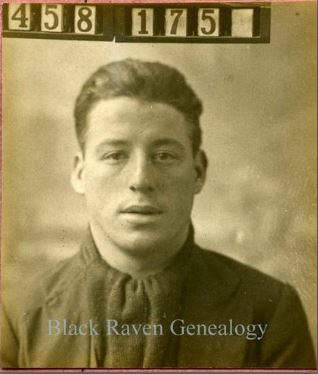
Thomas McGrane, c. 1919
Thomas McGrane was a first cousin of my great-grandfather, James Byrne. He was the youngest son of Francis Joseph McGrane and Margaret Byrne, born on 30 November 1898.[1] Thomas grew up in Lower Jane Place, off Oriel St. in Dublin city, where he was closer in age to James’s children than he was to James. 

His mother died when he was barely two years old, leaving his father with six surviving children - Elizabeth (14), Francis (10), Margaret (8), Bridget (6), Maryanne (4) and Thomas (2). His father married Mary Fay in June 1902, and it was Mary who reared Thomas. 

Like his cousin Benjamin Byrne, Thomas joined the British Merchant Navy in 1919. He first served on board the RMS Aquitania, travelling between Southampton and New York. Subsequently in 1919, he joined the crew of the SS Orbita,  again working on the North Atlantic route.[2] Presumably, on one such trip, he fell in love with New York and decided to make it his permanent home - at least, from 1922 onwards, New York became his base when he was not travelling the high seas.

SS Orbita, built in Belfast by Harland and Wolff, 1915

In November 1926, Thomas successfully petitioned for U.S. citizenship. At that time, he was living at 25 South Street, the address of the Seamen’s Church Institute, in New York.
[3] Many sailors of this era had no permanent home and instead used such ‘sailors’ accommodation’ when they were between ships.

The year after Thomas obtained American citizenship, while docked at the port of Los Angeles, he applied for a Seaman’s Protection Certificate.[4] Sailors often used these as passports, to prove their identity and nationality.

Various crew lists describe him as having brown hair, blue eyes and a fair complexion, and his height, though inconsistently recorded, was mostly given as about five feet, four inches tall. He was just a titch – like all the Dubs, then. His hair turned grey when he was still in his twenties.

Thomas McGrane (born in Dublin in 1898, died in New York in 1964)
Thomas McGrane, c. 1927

In common with many sailors then, Thomas wore tattoos. His right forearm featured a sailor’s grave and clasp hands, and the words ‘true love’. On his left forearm, he wore a cross in memory of his sister Margaret, who died, aged only thirty-two years, in 1924.[4]

Thomas continued to work as an able-bodied seaman for the next twenty years, first on steamships and then on motor-ships. The crew list of the Jeff Davis of New Orleans, arriving from Australia in 1935, records his next of kin as his mother ‘Mary of 6 Oriel Street, Dublin'.[5] He must have known his father died in 1931 - maybe the Seamen’s Church Institute operated a post-office service. Perhaps his travels even took him back to Dublin city every so often, where he got to spend a night or two with his family.

On 6 January 1946, Thomas arrived in Philadelphia from Gibraltar, on route to New York. This trip on the Royal S Copeland, a Liberty ship of World War II, was his last ever voyage as an able-bodied seaman.[5] A few months later, on 22 April 1946, he suffered a 'paralytic stroke', changing his life forever.[6] He was forty-seven years old and no longer able to work. He must have been heart-broken.

For many years afterwards, he survived on social welfare and the kindness of friends. Then, in 1953, he successfully applied for admittance to the Sailor’s Snug Harbor, a retirement home for merchant seamen, on Staten Island, New York. There, he spent the remainder of his days. He passed away on 2 January 1964 and was laid to rest in the Sailor’s Snug Harbor Cemetery.’[6]

Genealogy Quick Tip:
In May 2016, Ancestry (subscription site) released a collection of U.S. Applications for Seamen's Protection Certificates, 1916-1940, containing over 300,000 records of ‘seamen’s passports’ issued by U.S. customs officials. A small percentage of the records relate to Irish- born sailors with U.S. citizenship. Typically the application form contains the seaman's name, birthdate, and place of birth, as well as his father’s name and birthplace. It also contains the applicant’s photograph, physical description, signature and thumb print.


[1] Copy Birth Register, General Register Office.
[2] Irish Mariners, transcription of ‘CR10 series’ index card’, held by the Southampton Civic Archives.
[3] New York, Naturalization Records, 1897-1944, Ancestry.com
[4] U.S., Applications for Seaman's Protection Certificates, 1916-1940, Ancestry.com.
[5] New York, Passenger Lists, 1820-1957, Ancestry.com.
[6] Thomas McGrane, 1953, Application for Admittance to Sailor's Snug Harbor, accessed on 6 Generations Dublin.

Image Credits: Thomas McGrane, c. 1919, The Southampton Civic Archives; SS Orbita, Björn Larsson collection; Thomas McGrane, c. 1927, U.S., Applications for Seaman's Protection Certificates, 1916-1940, Ancestry.com.

……………….
© Black Raven Genealogy

Saturday, 28 May 2016

A storm in a teacup

In 1906, ‘Ma Power’, Granny’s foster-mother, got into trouble with the authorities and faced prosecution by the Society for the Prevention of Cruelty to Children and the Board of Guardians of Balrothery Poor Law Union. It was all a big storm in a teacup really, but the whole sorry saga was recorded in the minutes of the Board of Guardians and provides my only insight into Granny Lena’s life in foster care.  

Following her father’s death in April 1895, Lena O’Neill and her elder sister Joan, the two babies of the family, were placed in foster care with Mary Power in Malahide, Co. Dublin. Lena’s older brothers and sisters were less fortunate and ended up in various orphanages and industrial schools across Ireland.

Presumably, their mother was unable to provide for them, despite working as a musician and despite her remarriage to Thomas Ellis. All I know is, at some point between their father’s death and the 1901 census, the unthinkable happened, and Mary Agnes O’Neill/Ellis lost her children to the care of the state (and the church). And, even though the Victorians documented everything, until now, I’ve found no record of the family’s plight during this time.

The fuss with Ma Power kicked off in March 1906 when Miss Boylan, the Inspector appointed under the Infant Life Protection Act, carried out her first home inspection visit in Malahide. Miss Boylan complained to the Board that ‘Mary Power, Yellow Walls, refused to allow her to inspect the children stating that she had received instructions from the nuns of St Bridget’s [sic] Orphanage that no person should be allowed to inspect the children, the ages of the children were 12 and 10' [the same ages as Joan and Lena].’


Miss Boylan further reported ‘Mary Power, Yellow Walls, has four nurse children. The home has only two apartments, a room 10 x 15 feet and a kitchen. The Inspector points out that this woman keeps 7 dogs, and states that she had great difficulty making an inspection as the woman at first refused to allow her to do so.’

The Board then ordered ‘Copies [of the report] to be sent to the convents and orphanages from which these children were sent out to nurse, also to the Society for the Prevention of Cruelty to Children and the Board’s solicitor (Mr Early) to take proceedings against Mrs Power...’

Obviously, having seven dogs wasn’t an offence under the Act, for the solicitor wrote back to the Miss Boylan seeking ‘sufficient particulars to enable him to decide what proceedings should be taken against Mrs Power.'

And, somewhat strangely, the Superioress of St Brigid’s Orphanage replied stating ‘Mrs Power of Yellow Walls has not been on their staff of nurses for the past 3 years.’

In any case, Miss Boylan soon had a change of heart for her next monthly report to the Board was far more conciliatory in tone. She said ‘on revisiting these people they apologised for refusing an inspection in the first instance as they were not aware the Guardians had appointed an Inspector under the Infant Life Protection Act, and they promised to facilitate her in the discharge of her duties in the future.’

And with that, the Board ordered all prosecutions to be withdrawn.

There's lots of interesting information in these minutes that I’ve yet to digest, but more than anything else, I’d dearly love to hear what Ma Power and Granny Lena had to say about Miss Boylan and the complaint to the Board. I can imagine it was not complimentary. They probably thought she was an interfering old busybody.

Source: Balrothery Poor Law Union, Board of Guardian’s minute books A119 - A120, October 1905 to September 1906, accessed on Findmypast.

...................
© Black Raven Genealogy

Saturday, 21 May 2016

Ma Power

Today, I’d like to remember Mary (Leahy, Radcliffe) Power. Mary was a mother to so many different generations of my family – my great-grandfather, my grandfather, and my grandmother – but few people alive today have ever heard of her. According to my Aunt Maisie, she was known in the family as ‘Ma Power’.

In January 1869, soon after my great-grandfather’s first birthday, his mother died suddenly. Michael Byrne and his baby brother Thomas then went to live with their Aunt Mary. Mary became the only mother they ever remembered. She never had any babies of her own, yet the sound of children at play always filled her home.

Born Mary Leahy about 1842, Mary first married Christopher Radcliffe in 1866 and moved to his home village of Malahide, Co. Dublin. Christopher died in 1873, leaving Mary alone with the two boys and the following year, she married Michael Power. Over the subsequent decades, Mary Power continued to take in and care for children in need.

The 1901 census shows her, as a widow of fifty-four years, caring for five ‘orphan’ girls between the ages of six and eighteen years. Helena and Johanna O’Neill, the two youngest, may have been with Mary since their father died in 1895. Helena was my grandmother, later marrying Michael Byrne’s eldest son, but she could have been as young as three months old when she first arrived in Malahide. Perhaps this was when Mary acquired the name ‘Ma Power’.

In March 1903, Michael Byrne’s young wife Elizabeth died of phthisis (tuberculosis). Elizabeth's father, James Mahon, having watched his only child waste away before his eyes, was spared the final agony of seeing her die and passed away himself a month before her. At the age of only thirty-five years, Michael suddenly found himself alone in the house they had all shared, caring for his four young children.

Michael never remarried. I’ve often wondered how he managed to raise four children on his own and at the same time hold down his labouring job. When their mother died, they were all too young to take care of themselves. My grandfather, James Byrne, was only nine, his brother John was eight, their sister Margaret was six and the baby of the family, Michael, was three years old.

Neither Michael nor Elizabeth had any surviving siblings, so there were no aunts or uncles to offer assistance. Michael had no other relatives in the area at all, apart from his Aunt Mary. So, it must have been Mary who stepped in again and helped him raise his family. She lived just a few minutes’ walk up the road. 

And, there is some evidence this was the case. The 1911 census shows Mary’s grandniece, Margaret Byrne, staying in her home. You could argue it was only for one night, but it was probably a regular occurrence, suggesting the close relationship between them.
  
A modern picture of Ma Power’s house,
where many generations of my family spent their childhood

Mary Power died early in 1919, and although she did not leave a written will, at least none I could find, the Byrne family were her heirs. According to family lore, her house was left to my grandfather. He may have inherited it directly from Mary herself, or indirectly from his father. Either way, following Michael Byrne’s death in 1927, his daughter Margaret and her husband Peter Dignam moved into Mary’s house. There, they raised their family and spent the remainder of their days.

Mary Power was also fond of dogs, particularly terriers. Some years she kept as many as four dogs and was usually one of the first people to visit Swords courthouse each year to purchase her dog licences.

That’s not a lot to know about my great-great-grandaunt, a mother figure of such importance in my Dad’s family, but it’s a start.

…………………….
© Black Raven Genealogy

Saturday, 14 May 2016

His first family

If you’ve been doing genealogy for any length of time, you’ve probably already uncovered some family secrets. Occasionally these secrets are still shocking, even today – like bigamy, for example – that would probably still cause a stir.

There are no skeletons in our family closet, at least none I’ve found. And, maybe I wanted to liven things up a wee bit. Maybe, I just wanted to make some family skeletons dance. So, perhaps it was wishful thinking, when, for a brief moment, I wrongly suspected my great-great-grandfather of this woeful crime.

If you cannot get rid of the family skeleton, you may as well make it dance

John Byrne married Mary Markey in Dublin city in January 1860, a couple of weeks after their daughter Mary was baptised.[1] No further record of the family was found in Dublin. So, when John married my great-great-grandmother, Alicia Leahy, in the city, in January 1867, I assumed Mary had died - without having any more children. This was not the case, though.

While searching for what might have happened to their daughter, Mary, I came across another son, James. James Byrne was born on 16 August 1864 in Athgarvan, a small village near Newbridge in Co. Kildare.[2] John was from Athgarvan originally, so, after his marriage, he must have taken his young family home.

Four years and eight months separate the births of Mary and James, suggesting there were probably more children. And, the Newbridge Parish registers revealed a son Andrew was baptised on 24 August 1862 and a son John on 16 August 1863. The family’s address was recorded as ‘Kingstown and Athgarvan’ in 1862 and ‘Monkstown and Athgarvan’ in 1863.[3] Presumably, Mary lived in Athgarvan and John lived in Monkstown. He lived in Monkstown when he married Alicia, so this made sense.

Then, I searched forward in the baptism register and began to wonder just how long John and Mary were married. It was getting close to the time John met Alicia in Dublin. On November 1865, fifteen months after James was born, they had a daughter - Mary Anne Byrne.[3]

I admit; I held my breath as I searched forward once again. But, no more children were found. I probably owe a huge apology to my great-great-grandfather, but I did have a few reasons to fuel my suspicion:  

First, when John Byrne married Alicia, he incorrectly claimed to have been a bachelor, even though he was married to Mary for six years and had a bunch of kids with her. What was that about?

Secondly, Alicia did not live with John during their marriage. She lived in Kingstown, when he lived nearby in Monkstown. Add to that the fact John and Alicia lived in Co. Dublin, when John’s first family were in Co. Kildare!

Finally, until very recently, I knew nothing about my great-grandfather’s family or where he came from. That in itself was strange in the little village of Malahide, Co. Dublin, where Michael Byrne married my great-grandmother, and where everyone knew everything about their neighbours. So, I already half-suspected there was something to hide in my great-grandfather’s past.  

But, I was wrong. John’s first wife died in Athgarvan on 28 December 1865, a year before he married Alicia. Mary died of lung congestion after a six-week illness. John was with her at the time, and registered her death.[4]

I do feel sorry for John Byrne; he buried two wives before he reached his twenty-eight birthday. I wonder how many of his children survived, or did he bury most of them too. And, I wonder if my great-grandfather knew, or at least knew of, his (half) brothers and sisters. 
  
Genealogy Quick Tip:
Don't trust the index. If you know the Irish parish where a marriage or baptism likely occurred, always check the registers on the NLI website.  The transcriptions contain numerous errors and the identification of surname variants is not yet sufficiently comprehensive to be reliable. As a result, none of John Byrne and Mary Markey’s children were found using the Catholic Parish Registers on FindMyPast or Ancestry. Yet, all the baptisms were recorded.


More about John Byrne's origins: Escape to the Country.

[1] Church records, Parish of St Nicholas, 1859-60, IrishGenealogy.ie. 
[2] ‘Ireland Births and Baptisms, 1620-1881’, FamilySearch, citing Irish Civil Records. 
[3] Newbridge Parish baptism register, microfilm 04209/06, Andrew Byrne, p. 8; John Byrne, p. 13; Mary Anne Byrne, p. 23, NLI. 
[4] Copy death register (Mary Byrne, Naas, 1865), General Register Office.
Image adapted from one on Pixabay.

……………………
© Black Raven Genealogy