Sunday, 8 September 2019

James Tucker ~ a bad husband


I can't believe James Tucker! He was a first cousin of my great-grandfather, Patrick Wynne. All my first cousins are kind, decent people and I expected the same of my 'past' cousins. But, James Tucker, my first cousin, three times removed, doesn't quite fit the bill.

James was born on 21 July 1862, the fourth child and third son of James Tucker and Patrick Wynne's maternal aunt, Catherine Hynes. At the time, the Tuckers and my Wynne family shared a home at 104 Thomas Street, Dublin city. James grew up to be a brushmaker, like his father, like his brothers and like most of the Wynne boys. They were a close-knit family.

James Tucker was a civic-minded man. In 1887, along with his brothers Thomas and Joseph, he joined the Arran Quay branch of the Irish National League, and campaigned for political franchise and self-government in Ireland. He was also an active member of the United Society of Brushmakers, and represented the trade union in their disputes. It was inside closed doors the difficulties arose.

On 12 February 1888, James married Ellen Dorrington, née Bolger, a widowed shopkeeper, with an address at Upper Bridge Street, Dublin. The couple made 22 Upper Bridge Street their home and began a family. They had five surviving children:- Edward was born in 1889, Mary in 1891, Catherine in 1896, Annie in 1898 and Eileen in 1902. 

And, as might have been expected for this period in Irish history, they lost a number of children along the way. Their baby son James died of renal failure in 1894 when he was a year old, their son John died of measles in 1897, aged two years, and in 1900, their seven-month-old daughter Louisa died from convulsions. All in all, life seemed tragically normal for a family of the era.

Except, James Tucker was a bad husband!

Source: Evening Herald, 19 August, 1899 p. 4

Can you believe that? Nasty or what! It's too sad!

I suspect James Tucker may have been an alcoholic, and a mean drunk to boot. Alcoholism was perhaps a disease shared by other members of my Hynes family. There are some indications James' aunt Bridget, my great-great-grandmother, may also have suffered from this condition.

James spent much of the next decade of his life in and out of prison, and not just for assaulting his poor wife. He committed some pretty shameful crimes.

Further incarcerations:
  • In March 1902, for another assault on Ellen Tucker, he spent 14 days in Mountjoy Prison, before being bailed and discharged. 
  • In June 1904, he was committed to Kilmainham Gaol for a month, for 'having carnal knowledge of Lizzie Tracey, a woman aged 18 years.' 
  • In August 1904, he'd only just been released from Kilmainham, when he was charged with a crime of indecent assault, and sentenced to serve six months hard labour, in Mountjoy. 
  • In October 1906, he served seven days in Mountjoy for using 'profane and obscene language'. 
  • In July 1908, he was sentenced to two months in Kilmainham, for again assaulting his wife, but his sentence was commuted to one month. 

    Life must have been tough on the family, without their main breadwinner, during James Tucker's many stints in jail. Perhaps for poor Ellen, his periodic incarceration was a mixed blessing. It might explain why Ellen was working, outside the home, as a brush manufacturer, when the 1911 census was enumerated. It's not clear where James was at this time, although the Dublin electoral rolls place him at their home address in 1910 and 1912. Perhaps he was locked up somewhere.

    Physical description:
    The prison registers do provide a very good physical description of James Tucker. He was marginally over 5 foot, 4 inches tall, and of slim build, averaging between 129 and 140 pounds. He had brown hair, blue-grey eyes, a sharp nose and a fresh complexion, with a cut mark on his forehead.

    James Tucker got cancer of the rectum and died in the Mater Hospital in Dublin, on 8 June 1921. He was buried in Glasnevin Cemetery, Dublin. Ellen survived him by twenty-eight years.

    Sources available.

    Sunday, 25 August 2019

    John Tucker ~ kept the gun as a souvenir


    John Tucker was a first cousin of my great-grandfather, Patrick Wynne. He was born in Dublin city in 1873, the youngest son of James Tucker and Patrick’s maternal aunt, Catherine Hynes. In July 1932, John found himself accused of a gun crime. 

    The 'offender' in this case was a brush-maker by trade, with an address at Lombard Street, West, off the South Circular Road, just like my cousin. So, I'm happy it was definitely him. He was charged in the Dublin District Court with the illegal possession of a .45 Webley revolver, without the certificate required by the Firearms Act. 

    A Detective Officer Burns told the court he found the revolver in the possession of a young boy called Cooper at the South Circular Road. When Burns went to John Tucker’s house to question him about it, John admitted he had the gun since 1924. He kept it in the scullery of his home. The gun was issued to his son during his time in the Free State Army and John kept it as a souvenir when his son moved abroad. John didn’t think the revolver was any use.

    D.O. Burns then added that Cooper and a young son of the defendant were about to be charged with the offence as well. And, with that, the court adjourned, and the defendant was remanded on £20 bail, to appear again the following Friday.

    Except, the bloomin' newspapers didn’t follow up on the case the following week, so I don’t know what happened next! 😞

    They also left out some pertinent details I would dearly love to know. Like, whose gun was it originally? Which son served in the National Army during the civil war? He wasn't listed in the Irish Army census taken in November 1922. So, did he join up in the weeks afterwards?  And, where ‘out foreign’ exactly was he living at the time of the court case?

    Fergus Tucker and his bride Marie, 1948
    Also, which 'young son' was about to be charged? That must have been John’s youngest, Fergus Tucker. He was fourteen years old at the time, born at the end of 1917. His brothers were all adults. 

    I bet Fergus was in trouble at home after taking the gun outside to play, and as for for bringing the guards to the door!! 

    Still, he got over it. Fergus Tucker went on to become a well-known Dublin tenor, playing the cabaret scene in the 1960s and ‘70s.

    Source: Evening Herald, 26 July 1932, p.2; Irish Press, 7 April 1948, p. 2 and 7 July 1980, p. 1.

    Sunday, 11 August 2019

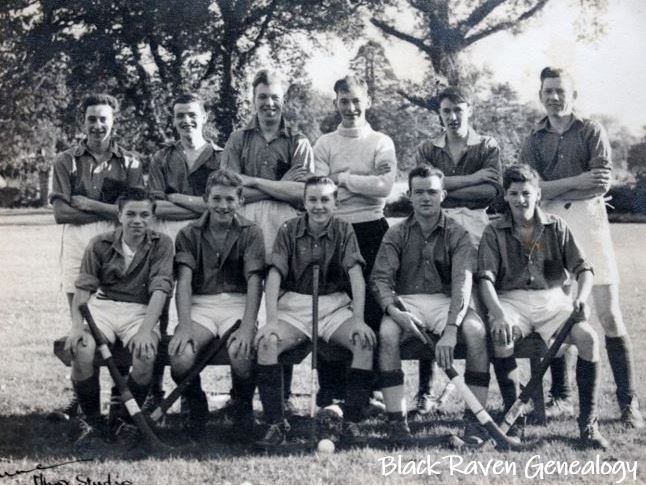
    Sunday Pictorial ~ Malahide Hockey Team c.1954-55

    Malahide Hockey Team c. 1954-55
    Back row: Joe Connolly, Henry O’Shea, John Gilmartin, David McSwiggan, Conor McMahon, Nicky Thompson. Front row: Richard (Dick) Thompson, Mick Byrne (my Dad), Brian Kearns, Conor Dignam, Jim Thompson.

    According to my Dad, the Hockey Team practiced in the Cricket field, at Malahide Castle. 

    Here's the picture 'colourised' via a free online service. They attempt to generate a plausible, although not necessarily accurate, representation of any black and white photograph. Maybe the boys look a bit off colour (it probably wasn't designed with our pale Irish skin in mind) but I like it. 


    If anyone knows any stories about the hockey team, I'd love to hear them.

    See ColouriseSG, as mentioned recently on DNAeXplained.

    Sunday, 28 July 2019

    What happened to Maurice Carroll?

    This post continues the series tracing the children of my great-great-grandfather, Maurice Carroll. He had five children with his first wife, Mary Anne Frazer, and ten children with my great-great-grandmother, Anne Radcliffe. Many of his children seemingly vanished in adulthood, but of them all, Maurice Carroll junior remains the most puzzling.

    Maurice was probably the youngest surviving son of my great-great-grandparents. He was born at the Baskin, near Malahide, in north county Dublin. According to his father, he was born on 20 June 1882, but his birth wasn't registered until 13 July, so the date may not be completely accurate. His baptism record is not available online. Maurice and Anne had an earlier son called Maurice, born in May 1877, but that child died shortly after his birth, and they used the name again.

    In the 1901 census, Maurice Carroll, stated age seventeen years (actual age nineteen years), was living with his parents and some of his siblings at 20 North Gloucester Place, in Dublin city. He was unmarried and working as a solicitor's general clerk. By the time of the 1911 census, or on census night at least, he wasn't living at home with his mother and siblings. His father had passed away in 1906.

    So where was he?

    The Dublin electoral registers, online for the years 1908 to 1915, show Maurice Carroll as the 'rated occupier' at 20 North Gloucester Place, in 1909. His mother Anne replaced him as the 'occupier' at the address from 1911 to 1913. And, Thoms Directory shows Maurice lived at 20 North Gloucester Place in 1910, but not in 1911. So, Maurice may have left home about 1910.

    A Maurice Carroll, born in Dublin on 22 June 1882 (two days after our Maurice's recorded birthday), declared the intention to apply for US citizenship, in Philadelphia, in May 1911. He had arrived in New York, via Calcutta, India, on 7 May 1911. Was this my great-granduncle?

    It's hard to be sure. But it could offer one explanation why he wasn't at home on census night that year. The timing seems right, although what he was doing in Calcutta is anyone's guess. Still, there was only one child with his name registered as born in all Ireland, in 1882 - my great-granduncle. So, it may well have been him.

    This chap worked as a groom, not a law clerk, but that's not necessarily a show-stopper. Our Maurice's father was a coachman and his elder half-brother Robert worked as both a coachman and a groom. Our Maurice grew up around horses. The guy in Philly had brown hair, and brown eyes, and was 5 foot, nine inches tall, and my family were typically a few inches shorter, with blue eyes, but who knows. His father was from Co. Tipperary and countrymen tended to be taller than Dubs.

    If this was my great-granduncle in Philadelphia in 1911, he came home to Ireland shortly thereafter. I'm fairly certain it was our man who joined Guinness Brewery in Dublin, in 1912, where he worked as a labourer in the cooperage department. The Guinness Archives show Maurice Carroll, born on 20 June 1882, joined the company on 2 October 1912. The Archives suggest he was unmarried at this time. He left their employment, having served just short of seven years, aged thirty-seven years, on 27 August 1919. To go where... I don't know.

    If you have any idea, or know anything else about him, I'd love to hear from you:- Blackraven.genealogy[at]gmail[dot]com.

    Sunday, 14 July 2019

    Annie Carroll – a tale of betrayal


    When my mother was young, she was eavesdropping on adult conversation and overheard her parents discussing a truly scandalous story. She believed they were talking about her Dad’s grandmother, Anne Carroll. Supposedly, Anne had married her sister’s husband, with whom she’d been having an affair, before her sister died. Shocking, right?

    Except further research revealed my great-great grandmother, Anne (Ratcliffe) Carroll, was an only child. Her mother died when she was an infant and her father emigrated to Australia, without her. It’s true, when they married, Maurice Carroll was a widower. But Anne was not related to his first wife. She was only eighteen years old when the lady died. No sister! No ongoing affair!

    So, I wondered, what exactly my mother might have overheard?

    Sometime later, I met another family researcher online. She was attempting to prove her relationship to the Singleton family, of Kirkham, England. Her great-grandmother Annie Whittle, aged five years, was ‘boarding’ with the Singletons, in 1881.

    Poor Annie Whittle was born out of wedlock in 1875. At the time, the Singletons had two boys, Thomas, aged ten years, and William aged six. It’s not clear why Annie ended up with them, but it seems she was raised as one of their own. Often, people described as 'boarders' in a census return were related somehow to someone in the household. Annie's maternal grandfather was a policeman, same as Mr. Singleton, and they may have worked together, so perhaps that was the long and the short of it.

    Roll on 1894, and the Singleton's son, William Smith Singleton, converted to Catholicism and married Anne Carroll’s daughter, my great-grandaunt, Annie Carroll.

    In 1897, Annie Whittle had a baby boy. She wasn’t married. She named her son William Smith Singleton Whittle. Why would she do that? Whatever about naming her son after a favourite ‘brother’, why would she include his surname as well? Unless she thought he was entitled to it!

    There is no sign of William Smith Singleton, his wife Annie (Carroll) Singleton, or indeed Annie Whittle, in the 1901 census, but little William Whittle, aged three years, was ‘boarding’ with the Singletons.

    Late in 1901, Annie Whittle had a second son, Robert Singleton Whittle.

    Tragically, by 1907, the ill-fated Annie Whittle had had enough. She was found drowned in a pond near where she worked. The newspaper cryptically reported her employer as stating, Annie ‘had never threatened suicide owing to her condition’. But sadly, seemingly it was a suicide, poor woman.

    Source: Lancashire Evening Post, 03 July 1907

    In 1911, my great-grandaunt, Annie (Carroll) Singleton, was the head of her household, at 3 Ethel Street, Newcastle upon Tyne, 150 miles from her home in Kirkham. There was no sign of her husband, and Annie was mysteriously using the name ‘Annie Smith’ - as if she wanted nothing to do with the Singleton name.

    Meanwhile, back in Kirkham, little William and Robert Whittle had ditched their birth surname, in favour of Singleton, and the Singletons claimed both of them as their grandsons. My great-grandaunt had dropped the Singleton surname, and the boys had taken it as their own.

    And, then there was my great-grandaunt’s curious last will and testament. Annie (Carroll) Singleton had no children. When she died in 1926, she left the bulk of her estate to her sister Mary, with a proviso that her husband be paid £2 a week, until he died. It was as if Annie didn’t want someone getting their unentitled hands on her life savings!

    Singleton family lore suggests William Smith Singleton fathered William and Robert Whittle. Maybe there was an issue with William Smith Singleton and Annie Whittle being together, given they were raised as siblings. But, perhaps William loved Annie Whittle. Perhaps he betrayed his wife, my great-grandaunt Annie Carroll, and continued an affair with her, his ‘sister’, even after he was married.

    Annie Carroll - an affair - the sister! This could have been the scenario my mother overheard her parents discussing. Except, William obviously did not marry Annie Whittle after his wife died.

    There was certainly enough heartbreak to go around in this family. My poor great-grandaunt seemingly had a sham marriage, Annie Whittle killed herself, and the two boys undoubtedly experienced quite an amount of undeserved shame regarding their circumstance of birth. As for William Smith Singleton, it seems he may have found love in the end. His ‘wife and son’, who as yet have not been identified, published a newspaper notice in his memory, on the first anniversary of his death.

    Source: Lancashire Evening Post, 6 February 1933, p.2

    Of course, I still need to find out what became of Annie (Carroll) Singleton's youngest sister, Margaret (Carroll) Penrose, to make sure she didn't play a part in this story. Unlike Annie's sisters Mary and Teresa, Annie did not mention her sister Margaret in her will.

    5 September 2021: More on Annie and Margaret's story here.

    Sunday, 30 June 2019

    Robert O'Carroll (1860-1942)


    This post continues the series tracing the children of my great-great-grandfather, Maurice Carroll. He had five children with his first wife, Mary Anne Frazer, and ten children with my great-great-grandmother, Anne Radcliffe, but many of them seemingly vanished after migrating to North East England. Robert Carroll, who in later years changed his name Robert O'Carroll, remained in Dublin.

    He was the second child born to Maurice Carroll and his first wife and was baptised in Donabate, Co. Dublin, on 25 July 1860. It's likely Robert was raised as Maurice's eldest son. No trace of his older brother David has been found, not since his baptism in St James’ Church in Dublin city, in December 1857, fourteen months before his parent's marriage.

    Robert Carroll was raised as a country boy in Balheary, near Swords, in north Co. Dublin. His father worked as a coachman for a wealthy family in the area. Robert's mother died of phthisis (tuberculosis) when he only seven years old, and seventeen months later his father married my great-great-grandmother. It's not clear who minded him, or his younger siblings, during the intervening period. When their mother died, James, the youngest, was only two years old.

    As a young man, Robert moved to Dublin city, perhaps following his father who lived in the city since before about 1888. Also like his father, Robert worked with horses. At various times during his lifetime, he was described as a coachman, a groom, and a livery man. Maybe he inherited that 'horse mad' gene, still prominent across some branches of Maurice Carroll's descendants today.

    On 16 September 1893, aged 33 years, Robert Carroll married Mary Dunne, a woman from Courtnacuddy, near Enniscorthy, Co. Wexford. They had their wedding ceremony in St Andrew's church, Westland Row, Dublin. Robert's brother James was his best man, while Mary's bridesmaid was an Agnes Lynch.

    Source: Catholic parish registers at the NLI, St. Andrew's, Microfilm 09500-02, p. 62

    Robert and Mary had nine children:-

    Mary Anne Carroll was born on 5 April 1894. At the time of the 1901 census she was staying with her uncle Michael Dunne in Courtnacuddy. In 1911 she was back living with her parents and siblings in Dublin. Then 16 years old, Mary Anne, or Marian G. as she was named, was working as a monitress, assisting the teacher in a primary school - a position reserved for the very best of students.

    Kathleen (a.k.a. Katie and Catherine) Carroll was born around 4 July 1895. Before the age of 15 years, she left school and worked as a biscuit packer in a factory, maybe Jacobs Biscuit factory. She married Joseph Prendergast, a soldier in the British Army, when she was 23 years old. After Joseph left the army, he worked as a shoe repairer, and they lived in Dublin city. Kathleen died of Hodgkin's disease on 16 February 1939, aged 43 years.

    Maurice Joseph Carroll was born on 14 September 1896. Sadly, on 1 September 1900, this little toddler died in a tragic accident at home. He fractured his skull in a fall from the top-floor window.

    Death Maurice Joseph Carroll, 4 years, son of Robert and Mary Carroll
    Source: Freeman's Journal, 4 Sep. 1900

    Robert Andrew Carroll was born 29 November 1898. He was found living with his uncle Michael Dunne in Co. Wexford when the 1911 census was taken. He became a bootmaker when he left school. Robert also died young. He caught tuberculosis and passed away, aged 18 years, on 31 March 1917.

    James Carroll was born on 19 January 1902. He became a shoemaker when he left school. James never married. He was the only one of Robert and Mary's four sons to outlive them. He was with them both when they died and registered their deaths. Poor James died in Portrane Mental Hospital, Co. Dublin, on 23 September 1957, aged 55 years. He suffered from emphysema for some years and died of chronic bronchitis. He was buried in Mount Jerome Cemetery, Dublin.

    Eileen Margaret Carroll was born on 20 September 1904. She married Joseph D. Fitzpatrick, a baker, on 14 February 1931 in the Church of St Nicholas, Dublin.

    Theresa Christina Carroll was born on 16 December 1906. She went by the name Rita. On 17 July 1940, she married Michael O'Grady, the librarian in the science library at U.C.D.

    Source: Irish Press, 18 Jul. 1940, p. 9

    Beatrice (Betty) Carroll was Robert and Mary's youngest daughter, born on 12 September 1909. Unmarried, she was bridesmaid for her sister Rita in 1940, but no record of her has been found since then.

    Raymond Vincent Carroll was their youngest son, born on 2 July 1912, though Robert and Mary had to bury this little tot too. He died of tuberculosis meningitis on 12 June 1917, the month before his fifth birthday, and two months after the death of his brother Robert.

    The end of the ninetheenth century saw a Gaelic revival in Ireland, where many families began reinstating either the O or Mc prefixes in their surnames. The Carrolls were no different. The first instance noted of the 'O' in their surname was in the 1911 Census of Ireland. However, the additon of the 'O' was sporadic after that, at least until the 1940s, when the change became permanent.

    Robert O'Carroll died at his home - 54 Larkfied Gardens, Dublin - on 9 November 1942. He'd had cancer of the mouth for eight months and succumbed to cardiac failure in the end. His wife Mary survived him by eight years and died on 24 November 1950. They were buried in Mount Jerome Cemetery, Dublin.

    Source: Irish Press, 10 Nov. 1942, p. 3

    If you are related to the O'Carroll family, I'd love to hear from you. blackraven.genealogy(at)gmail(dot)com.

    Sunday, 16 June 2019

    Great-granduncle John Carroll ~ a Black Sheep?

    My current genealogy challenge is finding out what happened to the children of my great-great-grandfather, Maurice Carroll. He had five children with his first wife, Mary Anne Frazer, and ten with my great-great-grandmother, Anne Radcliffe. Some of his children seemed to vanish into the abyss after migrating from Dublin to North East England and my goal is to trace them all.


    John Carroll was likely Maurice and Anne's eldest surviving boy. According to his father, he was born at Shanganagh Grove, Ballybrack, Co. Dublin, on 27 October 1878. In 1901, aged 22 years and single, he worked as a solicitors' general clerk, and lived with his parents and four of his siblings at 20 North Gloucester Place, Dublin city. 

    John wasn't found in the 1911 census, but a note added to his baptism register advised he married Selina Asher in St Mary's Cathedral, Newcastle on Tyne, on 27 February 1914. The marriage was witnessed by his sister, my great-grandmother, Teresa Wynne and a woman called Mary Briggs. The civil index of births, marriages and deaths in England and Wales confirmed the marriage, and indicated the couple had three children - Monica Carroll born in 1914, Eileen Carroll in 1916 and Desmond Carroll in 1917. Eileen died within six months of her birth.


    John Carroll, Dublin and Newcastle upon Tyne
    Source: RootsIreland.ie

    And, that's where I previously lost track of my great-granduncle, John Carroll. 

    Since then, many more record sets have been published online and I've managed to pick up his trail, again. And, it transpires, Uncle John was a bit of a black sheep.

    John Carroll's service in World War I
    First though, his World War I service record shows he enlisted at Sunderland, England and gave his home address, in September 1918, as 136 Frederick Street, South Shields. He was of slight build, 5 foot, 7 inches tall, with a chest measurement of 36.5 inches. He was working as a clerk in a shipbuilders when he was called up for service. 

    John Carroll served as a Pioneer with the London Electrical Engineers, but was honourably discharged after only a few months. His army medical records reveal he suffered from both tachycardia (a rapid heart beat) and pyorrhoea (gum disease, according to Google) and was accordingly declared physically unfit for war service. John was awarded the Silver War Badge in 1919. 

    The Swindle!
    Shields Daily News, 22 Oct 1924, p. 1
    Then, I came across a court case in the Shields Daily News concerning a John R. Carroll and his wife Selina, from 16 Bowman Terrace, Newcastle. John worked as a printer. All other accounts show our John was a clerk, and there's no other record he had a middle initial. The name John Carroll was not uncommon, even in England, BUT the combination John and Selina Carroll was probably quite unique. 

    John, Selina and two other men were involved in a scam whereby they presented fictitious invoices to the Waverly Hotel, Newcastle, for adverts supposedly placed in Carter's Directory and Hotel Guide. Time and time again, the hotel paid these invoices - to the tune of £278 - in 1924.

    However, it was all a con. No advertisiments were placed in any directory. 


    According to the newspaper article, the defendants each pleaded guilty to the charges in court. John Carroll also pleaded guilty to eleven similar offences against a ship chandler at Tynemouth. Plus, he had a record! In 1911, he was convicted of similar crimes in West Hartlepool and sentenced to two years hard labour, and in 1919, he served six months jail-time in Newcastle. Selina Carroll, on the other hand, had an unblemished record and said she didn't know she was doing wrong. She also claimed her husband used force to make her do it. Anyway, John was locked up, again, for twelve months with hard labour, while Selina (luckily, for the children) got off with a twelve-month suspended sentence. The two other lads got six months hard labour, each.

    So, was this poor fraudster my great-granduncle?

    It's difficult to prove there was only one couple named John and Selina Carroll living in England at the time, but the electoral registers do confirm there was only one registered to vote. Also, the electoral registers place John and Selina Carroll at that Bowman Terrace address from 1923 to 1933. In 1934, they seemingly moved to Royston Terrace, Newcastle and lived there for three years, and in the third year Monica Carroll was added to their electoral register. Our John and Selina had a daughter Monica, who'd just turned 21 years old. 


    Coincidence? I don't think so. It seems, these master criminals (not!) really were family. This story was swept well under the carpet. Not a rumour if it survived today, at least not back home, in Dublin.

    The death of John Carroll, aged 62 years, was registered in Newcastle upon Tyne, during the first quarter of 1941. The civil deaths index doesn't 'prove' he was definitely my great-granduncle. But, after the war, in 1945 and 1946, the resuming electoral registers do not reflect him living with his wife and family, so it probably was.